
Modern data centers operate in an environment where power reliability is directly connected to business continuity. As server density increases and IT equipment becomes more sensitive, even small electrical disturbances can affect performance, efficiency, and equipment lifespan. Among these challenges, data center harmonics have become a critical power quality concern that operators and system integrators cannot ignore.
At Enjoypowers, we develop advanced power conversion and power quality technologies designed for demanding industrial and commercial applications. Our data center power quality solutions focus on active harmonic filtering and reactive power compensation, helping data centers, colocation facilities, and edge computing infrastructure maintain stable electrical environments. Understanding the differences between active and passive filtering helps integrators choose the right approach for modern facilities.
Why Data Center Harmonics Require More Attention
The electrical systems inside today’s data centers are far more complex than traditional power environments. Servers, power distribution units (PDUs), uninterruptible power supplies (UPS), and other power electronic devices rely on switching technologies that can introduce harmonic currents into the electrical network.
Data center harmonics occur when nonlinear loads draw current in irregular patterns, creating waveform distortion. Although these issues may not immediately cause equipment shutdowns, long-term exposure can increase heat generation, reduce energy efficiency, and create additional stress on electrical components.
For facilities operating thousands of servers, maintaining clean power is essential. Modern server power supply units and PDU equipment often operate within strict tolerance limits, making effective harmonic management an important part of data center design.
Comparing Passive Filters and Active Harmonic Filter Data Center Solutions
When addressing harmonic problems, engineers typically consider two main technologies: passive filters and active filters. Each approach has different characteristics, making them suitable for different applications.
Passive filters use fixed combinations of capacitors, inductors, and resistors to reduce specific harmonic frequencies. They are generally simple in design and can be effective when the harmonic profile remains stable. However, passive solutions are usually designed for specific conditions and may become less effective when load patterns change.
Modern data centers often experience dynamic workloads, changing server configurations, and fluctuating power demand. Because of these variations, passive filters may not provide sufficient flexibility for many high-density facilities.
An active harmonic filter data center solution uses power electronics to monitor electrical conditions in real time and inject compensating currents to cancel unwanted harmonics. This allows active filters to respond to changing loads and maintain better power quality.
Advantages of Active Harmonic Filtering for Data Centers
Active harmonic filtering provides several benefits for facilities where electrical stability is critical. Unlike passive solutions, active systems can adapt continuously to changing operating conditions.
At Enjoypowers, our data center power quality solutions are designed around active harmonic filtering and reactive power compensation. These technologies help reduce harmonic distortion while improving electrical system stability for sensitive IT environments.
Active filtering is especially valuable in facilities with high-density computing equipment, mixed IT loads, or rapidly changing demand profiles. Colocation facilities, for example, may host multiple customers with different equipment configurations, creating complex harmonic conditions.
For these environments, flexible power quality management allows operators to address problems without redesigning the entire electrical infrastructure.
Selecting the Best Installation Strategy for Data Center Power Quality
The installation location of harmonic filtering equipment is an important consideration for system integrators. Different facility designs require different approaches based on load distribution, scalability needs, and operational priorities.
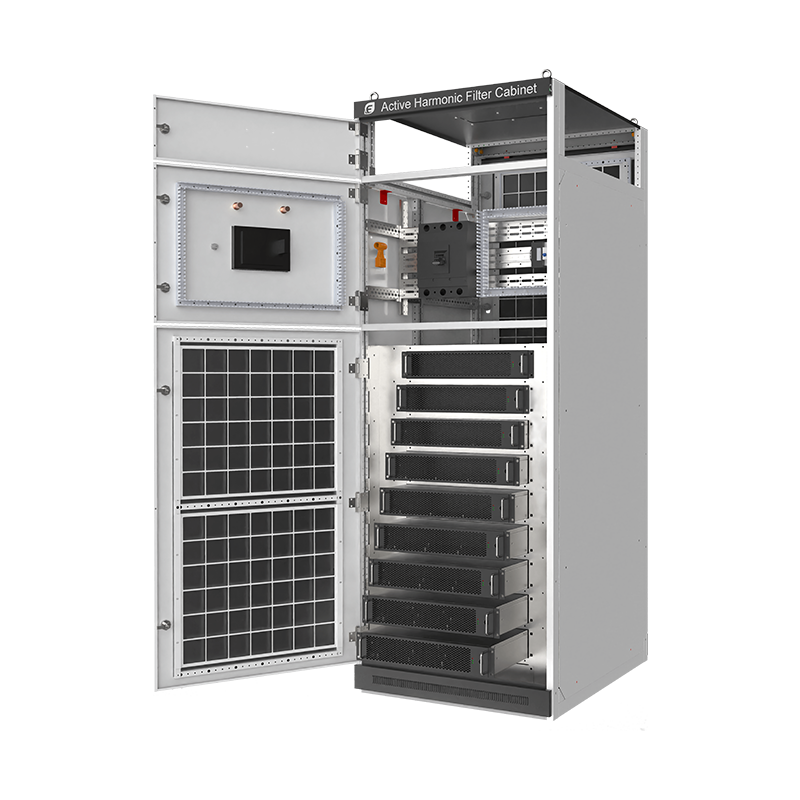
One common installation point is at the PDU level. An Active Harmonic Filter (AHF) combined with a Static Var Generator (SVG) can be installed at the PDU panel to filter harmonics from a specific data hall or rack row.
This approach works well for phased deployment, mixed-tenant colocation facilities, and areas with high-density computing loads. By targeting specific zones, operators can improve power quality where it is needed most.
Another option is facility-level installation at the utility intake or main bus. Larger AHF/SVG systems can filter aggregated harmonics from the entire facility. This approach is suitable for hyperscale data centers, dedicated single-tenant facilities, and sites with consistent load profiles across multiple data halls.
Supporting Reliable Operation with Redundant Power Quality Design
Reliability is a core requirement for Tier III and Tier IV data centers. Power quality equipment must not become a single point of failure, especially in facilities supporting critical digital services.
Enjoypowers designs solutions that support N+1 redundancy configurations for high-availability applications. With redundant modules, the system can continue filtering performance even if one unit requires maintenance or experiences a failure.
Our cabinet-integrated configurations provide additional flexibility. For example, a SinL Pro Cabinet equipped with 12 modules can operate with 11 active modules and 1 redundant module. This architecture allows data center operators to maintain power quality protection while improving system availability.
Building More Resilient Data Centers with Enjoypowers
As data centers continue expanding in scale and complexity, managing electrical quality is becoming a fundamental part of infrastructure planning. Harmonic distortion can impact efficiency, equipment reliability, and operational stability if it is not properly controlled.
At Enjoypowers, we provide advanced solutions designed for the demanding requirements of modern data centers. Through active harmonic filtering, reactive power compensation, and flexible installation options, we help system integrators improve electrical system reliability for critical IT infrastructure.
Choosing between passive and active technologies depends on facility requirements, but for dynamic environments where reliability and adaptability matter, an active harmonic filtering solution provides the flexibility needed for the next generation of digital infrastructure.