
Operating an aging industrial facility presents a constant technical balance between maintaining legacy electrical distribution infrastructure and integrating high-efficiency automated equipment. As modern variable frequency drives, CNC centers, and robotic automation join decades-old main distribution panels, facility power quality issues can become more difficult to manage. Plant engineers frequently encounter unexplained circuit breaker trips, severe transformer overheating, localized line noise, and escalating utility penalty fees that directly erode operational margins.
Resolving these deep-seated electrical disruptions requires moving far beyond simple reactive component swaps or piecemeal repairs. In this technical guide, we outline actionable engineering strategies to stabilize internal busbar voltages, suppress damaging harmonic currents, and reclaim lost distribution capacity across legacy plant networks without requiring complete multi-million-dollar switchgear overhauls or prolonged factory shutdowns.
Uncovering the Root Causes of Electrical Strain in Legacy Networks
Older manufacturing plants were designed primarily to support static, linear induction loads such as fixed-speed line-start motors, exhaust fans, and resistive heating elements. Traditional capacitor banks served this infrastructure reliably, switching fixed capacitor steps through electromechanical contactors to offset lagging displacement power factor. However, today’s industrial floors feature rapid load cycles, automated spot welders, and non-linear power electronics that switch thousands of times every second.
This operational mismatch creates two severe compounding failure modes within the distribution system. First, mechanical contactors require several seconds or even minutes to step in during load spikes, leaving the main busbar vulnerable to transient voltage sags and trip sensitive control automation. Second, aging dielectric insulation inside older capacitor units steadily degrades over time, losing rated microfarad capacity and shifting system resonant frequencies into highly destructive harmonic zones.
Balancing Speed and Capacity via Advanced Topologies
Addressing dynamic voltage fluctuations alongside legacy capacitor degradation demands a modern hybrid compensation architecture. Deploying hybrid reactive power compensation combines the bulk reactive power capacity of traditional step capacitors with millisecond-level solid-state inverter responses. Instead of completely scrapping functional passive assets, plant engineers can integrate a high-speed Static Var Generator alongside their existing capacitor step enclosures.
At Enjoypowers, we engineer dynamic power conversion architectures that split the compensation burden intelligently across hardware tiers. The static capacitor steps handle the persistent baseline inductive load, keeping baseline capital equipment costs low. Meanwhile, the active inverter module continuously injects precise counter-phase reactive current to absorb rapid transient swings, mitigate phase imbalances, and smooth heavy motor starts in real time.
Mitigating Harmonic Resonance and Voltage Distortion
When looking at power factor correction explained in traditional electrical engineering manuals, standard textbooks assume purely linear loads and predictable switching cycles. However, in modern facilities saturated with non-linear power converters, standard switched capacitors present lower impedance at higher frequencies, effectively drawing destructive harmonic currents into the capacitor cells. This creates severe parallel resonance, blown power fuses, and elevated total voltage distortion.
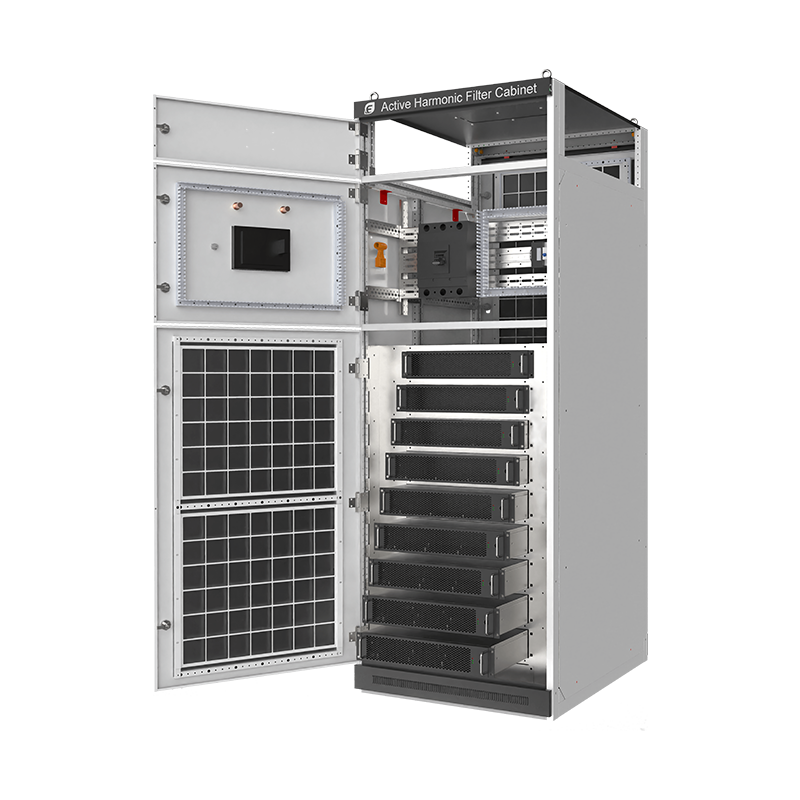
A modern hybrid framework effectively eliminates this resonance risk by combining detuned series reactors with active digital filtering logic. High-bandwidth Current Transformers continuously monitor downstream feeder currents and transmit fast feedback to the central processing core. The active filtering system can dynamically compensate harmonic currents, with Enjoypowers AHF solutions supporting harmonic filtering from the 2nd to the 50th order, purifying internal facility power while protecting passive capacitor banks from harmonic overloads.
A Practical 4-Step Retrofit Roadmap for Facility Engineers
Upgrading an active industrial plant requires minimizing operational downtime while establishing precise control integration across legacy switchgear cabinets. Beyond simple power factor correction explained in basic online guides, retrofitting a working manufacturing site demands accurate Current Transformer placement, optimized priority loop configuration, and detailed baseline electrical logging across peak production shifts.
We recommend executing the system retrofit through four structured implementation steps:
- System Audit & Logging: Connect a class-A power quality analyzer at the incoming main service entrance for at least seven full production days to capture peak kVAR demand and harmonic spectra.
- Capacitor Health Verification: Measure individual capacitor step currents and capacitance values across all existing stages to identify degraded modules and isolate operational passive steps.
- CT Network Integration: Mount split-core CTs at both the main utility bus and individual high-transient load feeders to feed real-time current vectors directly into the active inverter controller.
- Control Logic Optimization: Program the active module’s digital signal processor to prioritize dynamic voltage stabilization and harmonic cancellation before engaging electro-mechanical capacitor contactors.
During system integration, our team at Enjoypowers recommends sizing the active SVG inverter component to cover a selected share of the facility’s total required kVAR capacity. This targeted sizing approach provides a sufficiently fast dynamic response to eliminate sudden voltage dips while keeping overall capital investment manageable for plant upgrade budgets.
Operational Savings and Asset Lifespan Optimization
Upgrading power quality infrastructure delivers immediate operational and financial returns for aging industrial sites. Uncorrected low power factor triggers heavy monthly utility demand penalties, while elevated harmonic currents cause severe transformer core heating, conductor losses, nuisance breaker tripping, and premature insulation breakdown in motor windings.
Implementing a hybrid reactive power compensation solution provides the sub-cycle speed and harmonic mitigation of an all-active filtering system at a fraction of the capital expenditure. Facilities permanently eliminate utility low power factor penalties, free up valuable transformer headroom for expanded production lines, lower thermal stress on distribution gear, and protect sensitive automation equipment from disruptive voltage sags.
Furthermore, stabilizing internal grid voltage prevents costly unscheduled downtime across automated production lines. Industrial equipment operates within tighter voltage tolerances, leading to decreased maintenance costs, longer machinery lifespans, and reduced replacement frequency for sensitive electronic power supplies.
By partnering with Enjoypowers, facility managers can effectively modernize vulnerable legacy distribution networks into resilient, energy-efficient power infrastructures equipped to handle modern manufacturing demands.