
Industrial facilities operating variable frequency drives, arc furnaces, and switched-mode power supplies alter the sinusoidal shape of alternating current. Non-linear electronic loads draw current in abrupt pulses rather than smooth continuous waves.
Electrical utilities suffer grid instability, transformer overheating, and distribution line losses whenever facility current waveforms degenerate into distorted shapes.
Voltage distortion originates at the Point of Common Coupling, where private facility switchgear meets the distribution grid infrastructure. Harmonic currents flowing through utility source impedance create proportional harmonic voltage drops across the local electrical network.
Neighboring commercial customers experience severe power quality degradation because non-linear current distortion reflects back into upstream utility circuits.
Power quality issues worsen when high-frequency currents interact with facility wiring impedance. Harmonic components generate unexpected harmonic currents that loop between distribution transformers and non-linear power supplies.
Uncontrolled current distortion causes neutral conductor overloading, severe skin-effect resistive heating in busbars, and unexplained electronic equipment resetting throughout plant production lines.
How Grid Operators Measure and Bill Non-Linear Distortion
Electric utilities establish strict compliance thresholds based on IEEE 519 standards to protect shared distribution infrastructure. Grid revenue meters monitor Total Demand Distortion, comparing maximum harmonic current output against maximum fifteen-minute peak demand current.
Exceeding specific percentage thresholds triggers immediate financial penalties, structural tariff multipliers, or mandatory service disconnection notices.
Standard utility meters historically evaluated only displacement power factor derived from fundamental power frequency phase angles. Modern solid-state smart meters measure true power factor, incorporating total harmonic distortion directly into billing calculations.
High harmonic levels drastically depress true power factor metrics, causing unexpected demand charge penalties even when fundamental displacement metrics appear acceptable.
Modern industrial sites frequently invest in advanced power quality solutions to prevent billing surcharges and equipment thermal stress. Utility penalty structures vary between direct monthly dollar fines, increased peak demand multipliers, or reduced reactive power credit allocations.
Ignoring these billing line items guarantees compounding operational expenses year after year across commercial and industrial facilities.
Utility tariff penalty formulas calculate charges by evaluating distortion severity at specific point-of-measurement intervals. High distortion during peak demand hours attracts maximum financial surcharges because grid stress reaches critical levels simultaneously. Industrial operations that fail to log power quality data remain unaware of accruing penalties until utility invoice line items escalate dramatically.
Why Conventional Compensation Fails Under Non-Linear Loads
Legacy industrial facilities relied heavily on passive capacitor banks to correct low displacement power factor. Unfiltered capacitor steps create LC resonant circuits alongside upstream distribution transformer inductances. System resonance amplifies specific harmonic frequencies, producing severe current spikes, blown fuses, and catastrophic capacitor dielectric insulation breakdown.
Traditional passive power factor correction solutions often fail or experience severe resonance when high harmonic currents are present. Detuned reactors connected in series with power capacitors prevent destructive resonance but offer limited active attenuation. Passive filtering cannot adapt to dynamic load shifts common in modern automated manufacturing plants.
Distorted neutral currents represent another critical hazard created by triplen harmonics in three-phase four-wire networks. Third, ninth, and fifteenth harmonic currents add constructively in neutral conductors, exceeding phase current magnitudes. Facility transformers suffer severe eddy current losses, requiring aggressive thermal derating or premature structural transformer replacement.
Overheating in motor windings occurs because harmonic voltages induce reverse-rotating magnetic fields inside rotating electrical machinery. Fifth harmonic voltages produce negative sequence magnetic torque that actively opposes motor shaft rotation. Mechanical stress increases substantially, driving up electrical power consumption while causing premature bearing failure and insulation degradation.
Active Mitigation Architectures to Eliminate Surcharge Exposure
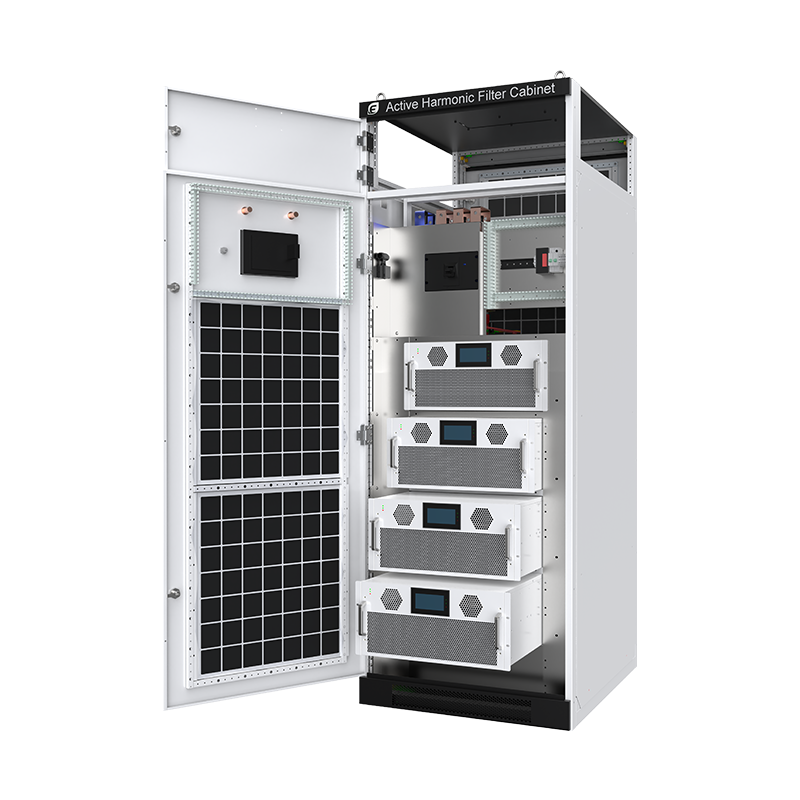
High-speed digital signal processing allows active harmonic filters to monitor load currents continuously in real time. Specialized current transformers capture non-linear distortion waveforms thousands of times per second. Digital processing algorithms isolate individual harmonic orders, instructing insulated-gate bipolar transistors to generate precise counter-phase current vectors.
Engineered specifically to counter complex non-linear distortion, Enjoypowers active harmonic filters dynamically inject compensating currents that cancel unwanted frequencies instantaneously. Canceling harmonic components directly at the facility busbar can reduce distortion and bring the current waveform closer to a sinusoidal shape before it reaches the utility revenue meter.
Deploying active power factor correction solutions alongside dynamic filtering supports both displacement power factor compliance and distortion mitigation. Static Var Generators utilize active inverter topologies to provide stepless, bidirectional reactive power injection in milliseconds.
Integrating active filtering with fast reactive compensation helps reduce grid penalties while maintaining unity power factor across rapidly shifting load cycles.
Active compensation systems adapt dynamically to changing operating states without risk of grid resonance. Intelligent control algorithms determine exact reactive power and harmonic current demands across variable operating conditions. Facilities maintain optimal power quality regardless of whether production machinery operates at partial load or maximum capacity.
Long-Term Power Quality Compliance and ROI Protection
Implementing targeted power quality solutions eliminates non-linear current pollution before it reaches the revenue meter. Comprehensive power audits utilize Class A power quality analyzers to identify non-linear load distributions throughout facility sub-panels. Mapping harmonic spectrums enables precise sizing and strategic placement of centralized or decentralized active compensation hardware.
Direct collaboration with Enjoypowers during grid compliance audits allows baseline power quality measurements to inform modular system design. Scalable active filter modules integrate smoothly into existing electrical switchgear, permitting incremental expansion as production lines expand.
Preventing utility penalty surcharges requires shifting from reactive component replacement to proactive active compensation. Adopting modular hardware from Enjoypowers helps manufacturing sites remain fully compliant with stringent utility interconnection agreements. Maintaining clean current profiles optimizes plant electrical efficiency, reduces thermal losses, and secures long-term operational profitability.