
A factory experiencing equipment trips, production interruptions, or unexpected electrical alarms may assume it has a general power quality issue. However, not every disturbance has the same electrical cause. Voltage sags and harmonics are two common problems that can affect industrial systems, but they develop through different mechanisms and require different correction methods.
The initial problem may remain unsolved if the wrong remedy is chosen. If the voltage drops momentarily, the system may require voltage support; if the waveform is distorted, current compensation may be more appropriate. Correct identification determines whether an investment actually improves electrical reliability.
A Voltage Drop Event and a Distorted Waveform Are Not the Same Problem
The most important difference between voltage sags and harmonics is the part of the electrical signal that becomes abnormal.
A voltage sag is mainly a voltage magnitude problem. The supply voltage temporarily decreases below its normal level, often for a short duration. Industrial facilities may experience these events because of grid faults, large motor starting operations, or sudden load changes.
The equipment connected to the affected circuit determines the severity of the impact. Motors may slow down, control systems may reset, and sensitive production equipment may stop if the voltage reduction exceeds operating limits.
Harmonics create a different type of disturbance. Instead of reducing voltage magnitude, they change the shape of the electrical waveform by adding unwanted frequency components. These distortions are commonly associated with nonlinear loads such as variable speed drives, power converters, and switching-based equipment.
This distinction is central to power quality management because the correction technology must target the actual electrical abnormality. A system cannot remove harmonics by simply increasing voltage, and it cannot prevent a voltage sag by only filtering current distortion.
When Equipment Stops During a Voltage Sag, Restoring Voltage Stability Comes First
A voltage sag becomes a serious industrial concern when critical equipment cannot maintain operation during a short disturbance.
Manufacturing facilities with automated processes often depend on stable voltage conditions. A brief interruption may stop production lines, interrupt control sequences, or require manual restarting procedures.
The solution focus is therefore maintaining acceptable voltage conditions for critical loads during the disturbance. Engineers typically analyze the affected loads, sag duration, voltage reduction level, and process sensitivity before selecting an appropriate response.
Energy storage-based systems, dynamic voltage support equipment, or other voltage stabilization technologies may be considered depending on the application requirements. The goal is to keep critical equipment operating when the incoming supply temporarily becomes unstable.
At Enjoypowers, we assess voltage-related conditions alongside other power quality factors to help determine the appropriate correction strategy. The correct solution depends not only on the electrical event itself but also on the operational consequences for the facility.
When Nonlinear Loads Pollute the Grid, Harmonic Control Becomes the Priority
Harmonic problems appear when electrical devices draw current in a non-sinusoidal pattern. Modern industrial equipment improves efficiency and automation but can also introduce waveform distortion into the electrical network.
Typical effects may include additional losses, transformer heating, reduced equipment efficiency, and interference with sensitive electrical systems.
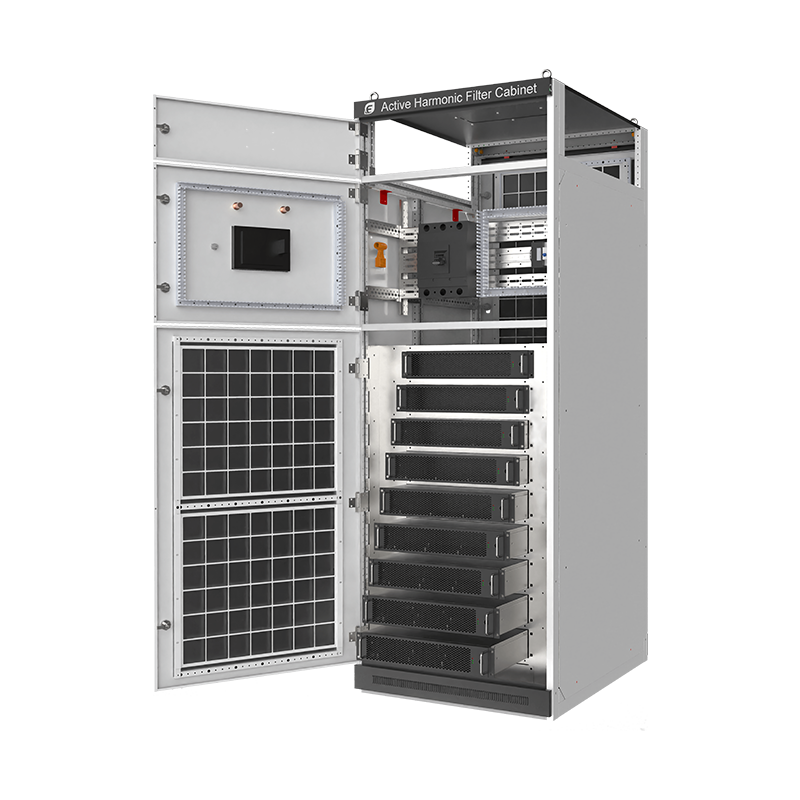
In these situations, harmonic mitigation solutions are designed to compensate for distorted current components rather than stabilize voltage levels. Active Harmonic Filters can monitor harmonic currents and generate compensating currents to reduce unwanted distortion in the electrical system.
Effective harmonic correction requires understanding where distortion originates and how it flows through the distribution network. Installing equipment without analyzing load behavior may fail to address the actual source of the problem.
Our power quality solutions at Enjoypowers are developed around measured system conditions. This allows industrial users to select correction methods based on actual electrical characteristics rather than assumptions.
The Wrong Correction Method Leaves the Original Problem Unchanged
One of the most common mistakes in power quality improvement is treating every disturbance as a single category.
A facility may install filtering equipment expecting it to prevent production losses caused by voltage sags. However, filtering focuses on waveform distortion and does not solve a temporary voltage reduction event.
Similarly, voltage regulation equipment cannot remove harmonic currents created by nonlinear loads. The disturbance may continue even after a major investment if the technology does not match the problem.
A correct diagnosis separates two questions:
What is happening to the electrical system?
Which technology directly addresses that mechanism?
This diagnostic approach reduces unnecessary upgrades and improves the probability of achieving measurable results.
A Practical Path From Power Quality Diagnosis to System Improvement
A reliable improvement process starts with measurement rather than equipment selection.
Engineers first nee
d to identify whether the primary disturbance involves voltage variation, harmonic distortion, or multiple power quality factors occurring together. Monitoring data provides visibility into event frequency, severity, and system behavior.
After the disturbance type is confirmed, the correction strategy becomes clearer. Voltage-related issues require solutions focused on maintaining supply stability, while harmonic issues require technologies that control waveform distortion.
Enjoypowers applies this problem-solving approach through customized power quality management solutions designed for commercial and industrial environments. Instead of applying a universal fix, we focus on matching the correction method to the electrical challenge.
Voltage sags and harmonics may both interrupt industrial operations, but they are not interchangeable problems. Understanding their differences allows facility operators to choose the right technology, improve system reliability, and avoid investments that fail to solve the real cause.
The most effective power quality improvement begins with one simple decision: identify the disturbance correctly before selecting the solution.