
Steel mills operate under some of the most harsh and unforgiving power quality environments found in heavy manufacturing. High-tonnage Electric Arc Furnaces create chaotic, non-linear current spikes during initial scrap metal cave-ins, causing severe voltage flicker across regional power grids.
At the same time, high-power rolling mill motor drives create pervasive electrical noise, causing transformer overheating and tripping sensitive automation systems throughout the plant.
Managing these twin electrical challenges requires moving far beyond basic power factor correction or standard passive filter banks. Steelmaking requires specialized conditioning gear built to withstand sub-cycle reactive power surges and severe ambient dust, heat, and electromagnetic interference.
Deploying robust power quality solutions for manufacture allows heavy industrial sites to maintain continuous melting operations, help reduce grid compliance fines, and safeguard critical electrical infrastructure.
When scrap metal arcs ignite inside a furnace, the instantaneous current draw swings violently between open-circuit and short-circuit conditions within milliseconds. This unpredictable load pattern pulls massive inductive reactive power from incoming utility lines, causing deep voltage sags that propagate through upstream sub-distribution buses.
Without fast dynamic stabilization, these transient drops degrade product quality and trigger unexpected control system shutdowns across neighboring machinery.
Sub-Cycle Reactive Compensation for Flicker Reduction
Attenuating furnace-induced voltage flicker demands response times far faster than traditional electromechanical contactors or thyristor-switched capacitor banks can provide. Mechanical switching mechanisms introduce multi-cycle delays, allowing rapid voltage dips to trigger visible light flicker in nearby communities and violate utility interconnection codes. Heavy industrial grids need continuous, stepless reactive power injection capable of matching the exact rate of arc fluctuation.
At Enjoypowers, we address this intense dynamic demand by deploying high-voltage, high-capacity Static Var Generators utilizing advanced Insulated Gate Bipolar Transistors.
With response times of up to 5 ms, these active power systems generate precise capacitive or inductive current vectors to counteract instantaneous furnace fluctuations. Fast sub-cycle injection stabilizes busbar voltages, helping reduce short-term flicker severity and support compliance with applicable grid requirements.
Maintaining bus voltage stability during primary scrap melting cycles improves the active power transfer efficiency of the arc furnace itself. Stable voltage levels reduce secondary arc extinction events, leading to shorter heat times, lower electrode consumption, and measurable kilowatt-hour savings per ton of steel produced. Consequently, fast reactive power compensation delivers significant metallurgical productivity gains alongside grid code compliance.
Eliminating Harmonic Distortion from Rolling Mill Drives
Further down the manufacturing process, heavy rolling mills depend on massive variable frequency drives to control multi-ton steel billets with high precision. However, the high-power AC-to-DC rectifiers driving these motor systems draw non-sinusoidal current, generating significant low-order and high-order current harmonics. These harmonic frequencies circulate through the internal distribution network, distorting voltage waveforms and overloading main distribution transformers.
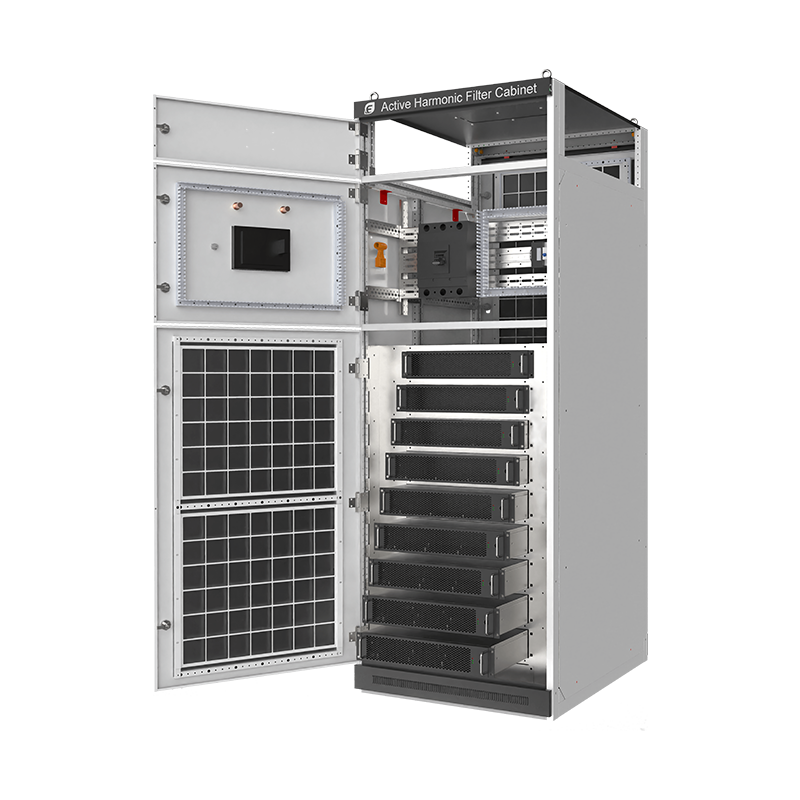
Implementing targeted VFD harmonic mitigation protects internal distribution transformers from thermal overload and eddy current losses caused by high-frequency currents. Active harmonic filters continuously monitor load currents via wide-bandwidth current transformers, calculating distortion profiles in real time.
The digital signal processor instantly drives power electronics to inject equal, phase-opposed harmonic currents, neutralizing distortion before it reaches the main incoming utility busbar.
Unfiltered drive harmonics also create dangerous parallel resonance conditions with conventional power factor capacitors installed in older plant switchgear. High harmonic currents cause capacitor dielectric breakdown, blown fuses, and catastrophic switchgear fires.
Active filtration continuously cancels harmonic currents across fluctuating drive load cycles, preserving equipment integrity and reducing the risk of harmonic resonance in the facility network.
Engineering Multi-Layered Hybrid Mitigation Topologies
Mitigating power quality issues across a high-MVA steel manufacturing site requires an engineered hybrid system topology that balances capital expenditure with dynamic performance.
Combining large passive LC filter branches with high-speed active power electronics provides a highly cost-effective solution for heavy industry. The passive filter elements handle baseline reactive power demands and high-magnitude lower-order harmonics, while our Enjoypowers active filtering modules tackle fast transients.
Integrating advanced VFD harmonic mitigation into a coordinated hybrid architecture prevents active filtering modules from overloading during extreme load spikes. Digital control logic prioritizes dynamic voltage stabilization and high-order harmonic cancellation, delegating steady-state base compensation to tuned passive banks.
This coordinated approach optimizes equipment sizing, reduces thermal losses within power conditioning cabinets, and lowers overall capital investment for plant upgrades.
Industrial-grade module construction remains essential when installing power electronic equipment in steel mill environments. Advanced enclosure designs feature isolated cooling channels, conformal-coated circuit boards, and heavy-duty copper busbars designed to handle intense ambient heat, metallic dust, and heavy vibration. Robust physical construction ensures continuous inverter performance under harsh operational conditions typical of modern meltshops and hot rolling mills.
Maximizing Plant Productivity and Operational ROI
Investing in comprehensive power quality infrastructure can provide operational and financial benefits over time for steel production facilities. Eliminating voltage flicker and harmonic distortion prevents costly utility non-compliance penalties, lowers monthly peak kVA demand charges, and avoids unscheduled mill stops.
Stable internal electrical power preserves delicate automation systems, reduces electrical component failure rates, and extends the operational lifespan of expensive plant machinery.
Deploying tailored power quality solutions for manufacture empowers steel producers to scale operational capacity without exceeding utility interconnection limits or risking internal grid failure.
Cleaner power improves overall facility power factor to near-unity levels, freeing up critical transformer MVA capacity for future expansion projects. Reduced line losses and optimized furnace power delivery directly lower energy expenditure per ton of finished steel.
Through engineered active compensation and dynamic filtering, modern steel plants transform unstable, highly disruptive electrical loads into clean, grid-compliant industrial facilities.
By partnering with Enjoypowers, steel manufacturers secure the technical expertise and robust power quality infrastructure required to maintain peak production efficiency, protect critical plant assets, and achieve total power quality compliance.