
Modern commercial and industrial solar-plus-storage installations rely on continuous operational visibility to support efficient operation and help identify conditions that could contribute to unplanned interruptions.
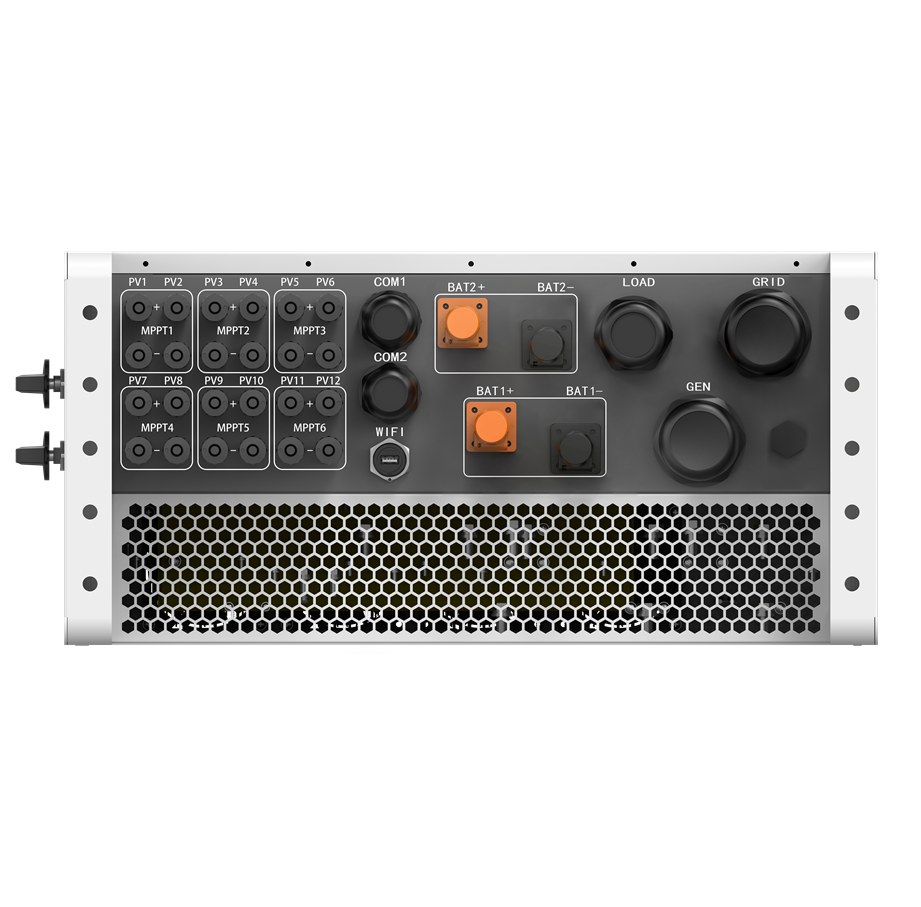
Integrated communication gateways can collect digital telemetry from power conversion switchgear, streaming live performance data to cloud dashboards via Modbus RTU, Ethernet, or cellular networks.
Understanding precisely what metrics can be tracked remotely allows facility engineers and energy asset managers to optimize daily battery dispatch schedules, safeguard high-value battery cells, and troubleshoot electrical anomalies without stepping foot on site.
DC and AC Power Flow Telemetry Across Inverter Stages
Photovoltaic array tracking begins at direct current input terminals, where digital transducers log voltage, current, and kilowatt yield for each independent maximum power point tracking channel.
Cloud management dashboards graph live generation curves against historical irradiance baseline data, revealing panel degradation, localized shading, or blown string fuses.
Converting raw direct current from solar strings or battery modules into grid-compliant alternating current demands continuous thermal and electrical supervision of internal switching bridges.
Remote telemetry logs line-to-line AC voltages, output currents, power factor, and active power synthesis across every connected phase.
Cloud-connected communication gateways developed by our team at Enjoypowers enable centralized platforms to collect detailed power conversion data and provide real-time visibility into system operation.
Operators continuously evaluate instantaneous conversion efficiency to verify that internal switching losses remain well within designed thermal limits across varying ambient temperatures.
Deploying a robust three phase hybrid inverter across industrial facilities ensures balanced AC power delivery while providing granular line-by-line voltage and phase-angle telemetry. Monitoring phase symmetry can help identify abnormal current distribution and support earlier investigation of conditions that may contribute to transformer heating or protection trips.
Battery Management System Synchronization and Cell-Level Health Metrics
Bidirectional energy storage control depends on continuous data exchange between the inverter processor and the battery management system over high-speed CAN bus connections.
Cloud dashboards visualize state of charge percentages in real time, showing operators whether batteries are actively charging, discharging, or holding standby capacity.
Battery state of health tracking provides essential insight into long-term chemical capacity retention across thousands of operational charge cycles. Plant managers log cumulative energy throughput alongside charge-discharge cycle counts to forecast asset replacement schedules and verify battery warranty compliance.
Operating an all-in-one hybrid inverter simplifies system telemetry integration because power conversion electronics and energy management software operate on a unified internal data bus.
Users track maximum allowable charge and discharge current limits dynamically adjusted by the battery management system based on real-time cell temperatures.
Cell voltage delta metrics identify internal battery string imbalances before individual lithium cells suffer permanent over-voltage or under-voltage degradation. The BMS can manage cell balancing according to its protection and balancing logic, while the monitoring platform can display relevant cell-voltage data and issue alerts.
Grid Interconnection Stability and AC Load Monitoring
Interconnection points require constant monitoring of grid voltage and frequency parameters to ensure compliance with strict regional utility grid codes. Remote telemetry captures fast transient voltage sags, over-voltage spikes, phase imbalances, and utility frequency deviations across local distribution feeders.
Active power flow metrics distinguish between self-consumed solar energy, battery storage discharge, and direct utility grid purchases in real time. Directional power indicators reveal exactly how much electricity a commercial facility imports during peak tariff windows, helping managers refine operational dispatch logic.
Reactive power telemetry measures instantaneous power factor across facility main switchboards. Modern monitoring software logs displacement power factor alongside total harmonic distortion values, identifying severe power quality degradation created by variable frequency drives or non-linear industrial loads.
Critical load sub-panels connected to dedicated backup inverter terminals receive specialized monitoring during utility grid outages. Facility personnel track remaining battery discharge run-time estimates under real-time load profiles, permitting selective load shedding to extend critical backup operation.
Cloud-Based Alarm Diagnostics and Automated Fault Telemetry
Immediate notification of electrical faults represents one of the most vital functions of modern cloud monitoring platforms. Embedded firmware algorithms generate categorized fault codes and automated push notifications whenever operating parameters exceed defined safe operating boundaries.
Advanced telemetry architectures developed by Enjoypowers support rapid error isolation by attaching high-frequency oscillogram snapshots to severe fault event logs. Maintenance engineers analyze captured voltage and current waveforms recorded milliseconds before and after protective circuit breakers trip.
Isolation resistance tracking continuously measures electrical insulation integrity between high-voltage DC conductors and ground chassis. Decreasing insulation values warn operators of moisture ingress inside conduit runs or damaged panel backsheets long before ground faults trigger emergency system shutdowns.
Internal temperature sensors distributed across IGBT power modules, magnetic inductors, and heat sinks deliver continuous thermal logs. Automated heat alerts notify facility managers if cooling fan arrays suffer mechanical blockages or enclosure ambient temperatures exceed rated operating specs.
Remote Firmware Execution and Fleet Energy Optimization
Modern cloud platforms move beyond passive telemetry logging by offering secure bidirectional control and remote system reconfiguration. Facility managers adjust time-of-use discharge schedules, peak demand charge capping limits, and reserve battery SOC settings directly through intuitive web interfaces without sending technicians to the field.
Updating inverter control firmware remotely eliminates costly on-site service calls across geographically distributed commercial energy assets. Central cloud servers push thoroughly tested software updates to an all-in-one hybrid inverter fleet, optimizing control loops and updating utility grid-support parameters.
Deploying a flexible three phase hybrid inverter enables operators to reconfigure dynamic grid-support functions, including volt-var curves and frequency-watt response parameters remotely. Where supported by the system and applicable grid-code settings, remote configuration can help operators update control parameters when interconnection requirements change. Any changes should still be validated against the applicable utility requirements.
Integrating smart cloud control with an Enjoypowers conversion platform allows asset managers to consolidate multi-site energy telemetry into comprehensive executive reports.
Automated performance analysis can help identify underperforming solar strings or degraded battery assets and support more effective asset management.