
Sudden distribution grid outages disrupt industrial production lines, trigger data server reboots, and cause severe financial losses across commercial facilities. Traditional backup generators require anywhere from ten seconds to two minutes to start and stabilize voltage, leaving critical facility loads vulnerable to total power loss.
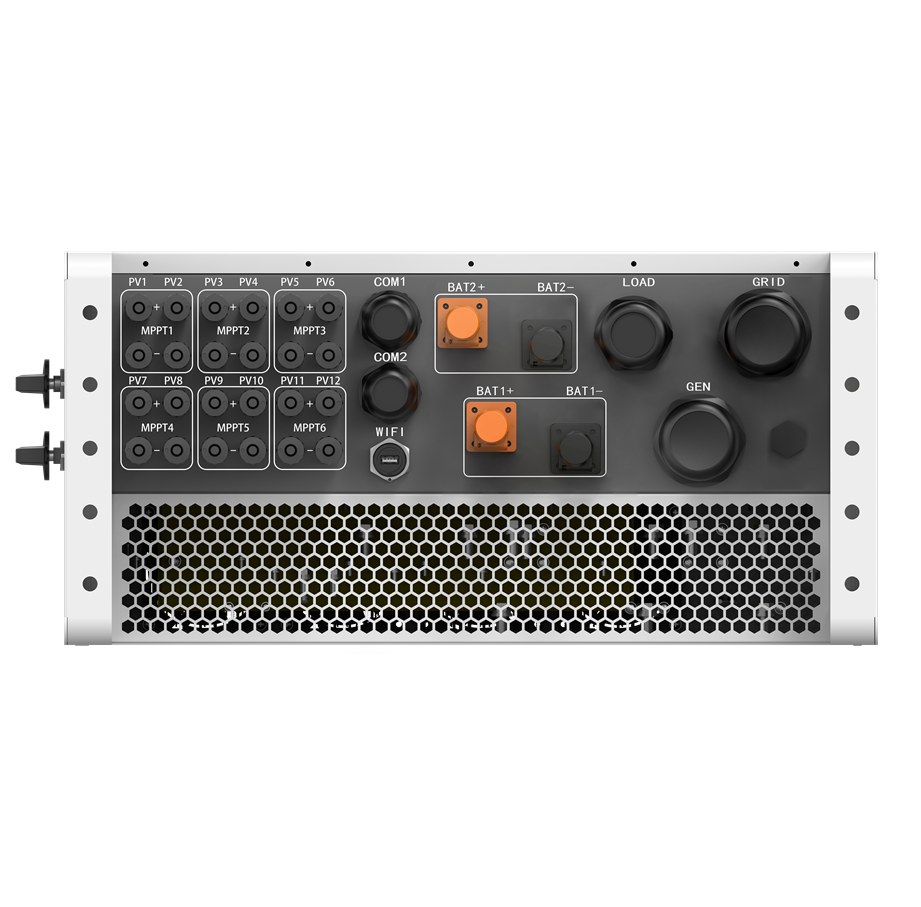
Modern hybrid conversion architectures solve this operational vulnerability by unifying solar generation, battery storage, and solid-state grid transfer mechanics inside a single high-efficiency power enclosure.
Achieving true uninterruptible power delivery during a utility blackout demands continuous electrical monitoring, ultra-fast physical isolation, and instantaneous firmware control loop reconfiguration.
Examining the precise sequence of events—from initial fault detection to re-grid phase alignment—reveals how advanced energy storage platforms maintain smooth, sub-10-millisecond power transfers for sensitive industrial loads.
Grid Failure Sensing and Fast Fault Detection Thresholds
Seamless transition begins with continuous high-frequency sampling at the inverter grid connection terminals. Integrated digital signal processors analyze three-phase AC voltage waveforms thousands of times per second, calculating RMS voltage magnitudes, instantaneous frequency stability, and phase angle trajectories in real time.
Utility anomalies manifest as severe voltage sags, sudden phase jumps, frequency excursions, or total loss of grid potential. Whenever sampled grid parameters cross pre-programmed IEEE 1547 or local grid code protection boundaries, internal protection and control algorithms detect abnormal grid conditions and initiate the transition sequence.
Continuous monitoring ensures sub-cycle fault isolation across both high-voltage spikes and subtle brownout conditions.
Speedy fault recognition prevents power conversion circuits from driving current into an unpowered or short-circuited distribution network. Distinguishing between brief grid voltage transients and genuine utility blackouts ensures that the switching mechanism triggers only when physical isolation becomes mandatory.
Silicon Controlled Rectifiers and Solid-State Transfer Isolation
Physical isolation relies on high-speed Static Transfer Switch assemblies positioned between internal inverter buses and incoming utility power lines. Mechanical relays and contactors operate far too slowly for sensitive electronics, taking 30 to 100 milliseconds to open contact points. Solid-state switches utilize antiparallel Silicon Controlled Rectifiers capable of opening circuits within microseconds.
At Enjoypowers, we engineer solid-state static transfer switches that block gate drive signals to the rectifiers instantly upon fault detection. Cutting off gate signals forces the solid-state switch to cease conduction at the very first current zero-crossing point.
Rapid physical isolation helps limit the risk of unintended backfeeding and supports fast transition to the off-grid operating state. Rapid disconnection protects maintenance workers operating on external distribution lines while isolating internal facility sub-panels into an independent microgrid.
Downstream critical loads continue running without experiencing voltage sag or harmonic distortion during the switch.
Control Loop Mode Transition: From PQ Current Source to VF Voltage Source
Isolating the facility grid addresses physical safety, but maintaining uninterrupted power requires an immediate shift in inverter control algorithms. While grid-connected, power conversion electronics operate in PQ mode, functioning as a controlled current source that injects active and reactive power into a rigid utility grid voltage reference.
Disconnecting from utility lines removes that external voltage reference entirely. Control firmware must instantly switch from PQ current control to Voltage-Frequency mode, converting the inverter bridge into an independent, regulated AC voltage source.
Executing this complex control loop transfer in under ten milliseconds prevents AC bus voltage from collapsing below equipment operational thresholds. Deploying a commercial-grade 40 kW hybrid inverter allows facility managers to maintain uninterrupted three-phase voltage output across critical motor drives and automated assembly equipment during grid losses.
Operating a high-capacity 60 kW hybrid solar inverter provides the thermal headroom and dynamic current capacity needed to support heavy inductive load inrush currents during off-grid voltage formation. Smooth voltage formation keeps sensitive industrial electronics running without experiencing power dips, control resets, or phase angle distortion.
Phase-Locked Loop Synchronization and Reconnection Dynamics
Restoring main utility power requires an equally precise reverse switching sequence to avoid destructive current surges across inverter power modules. When external grid voltage stabilizes within normal operating parameters for a mandatory observation window, the inverter control system prepares for grid reconnection. Automated synchronization timers ensure grid voltage stability before initiating phase-matching protocols.
Closing a static switch onto out-of-phase utility power generates massive circulating currents capable of tripping protective breakers or damaging switching semiconductors. Internal Phase-Locked Loop algorithms continuously measure external grid phase angles and gradually shift the off-grid inverter output waveform to match grid frequency and phase alignment precisely.
Our engineering teams at Enjoypowers optimize Phase-Locked Loop synchronization routines to lock inverter output within a five-degree phase angle difference of incoming utility power. Once phase alignment and amplitude symmetry are confirmed, the control system issues a simultaneous reclose command.
Re-conducting the static transfer switch occurs seamlessly without interrupting plant operations. Simultaneously, inverter firmware transitions smoothly from VF voltage formation back to PQ current control, resuming normal solar-plus-storage peak shaving or self-consumption routines.
Sizing Hybrid Storage Hardware for Uninterrupted Industrial Backup
Matching hybrid conversion hardware to facility electrical loads requires evaluating peak surge demands, battery discharge C-rates, and total critical load capacity. Commercial sites with moderate backup requirements frequently integrate a 40 kW hybrid inverter to shield essential control panels, security infrastructure, and lighting circuits from sudden grid collapse.
Facilities operating heavy machinery or large HVAC chillers benefit from deploying a 60 kW hybrid solar inverter capable of delivering higher continuous AC power for larger critical-load requirements.
Higher power density ensures that sudden motor starting currents do not trigger emergency thermal derating or voltage dropouts during off-grid operation.
Partnering with Enjoypowers gives plant integrators access to IP66-rated hybrid architectures engineered specifically for demanding commercial and industrial energy applications.
Unifying fast solid-state transfer hardware with intelligent control firmware provides reliable grid independence, optimizes operational energy resilience, and protects valuable enterprise infrastructure against grid instability.