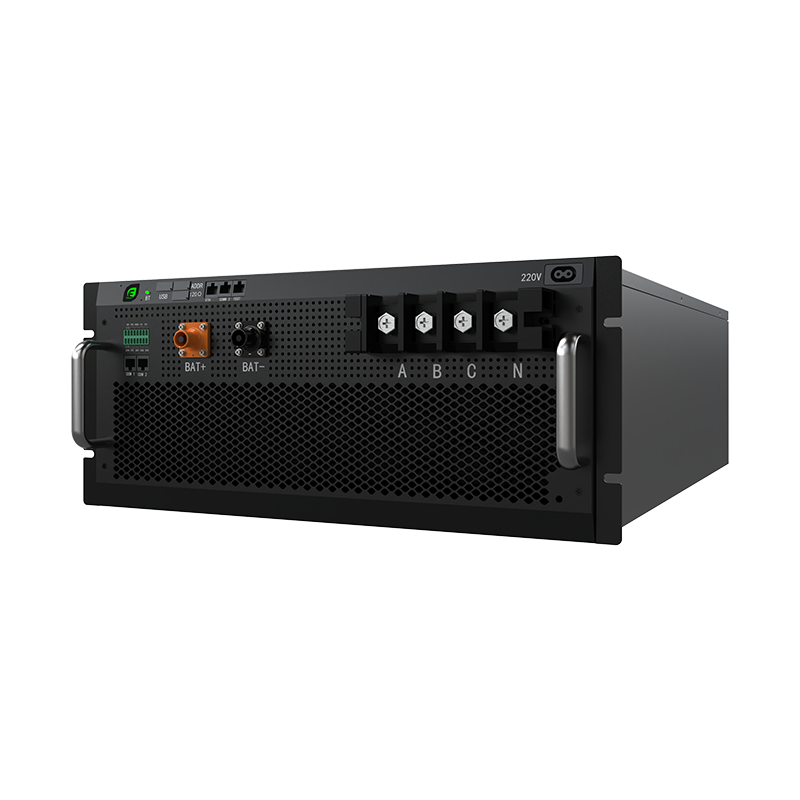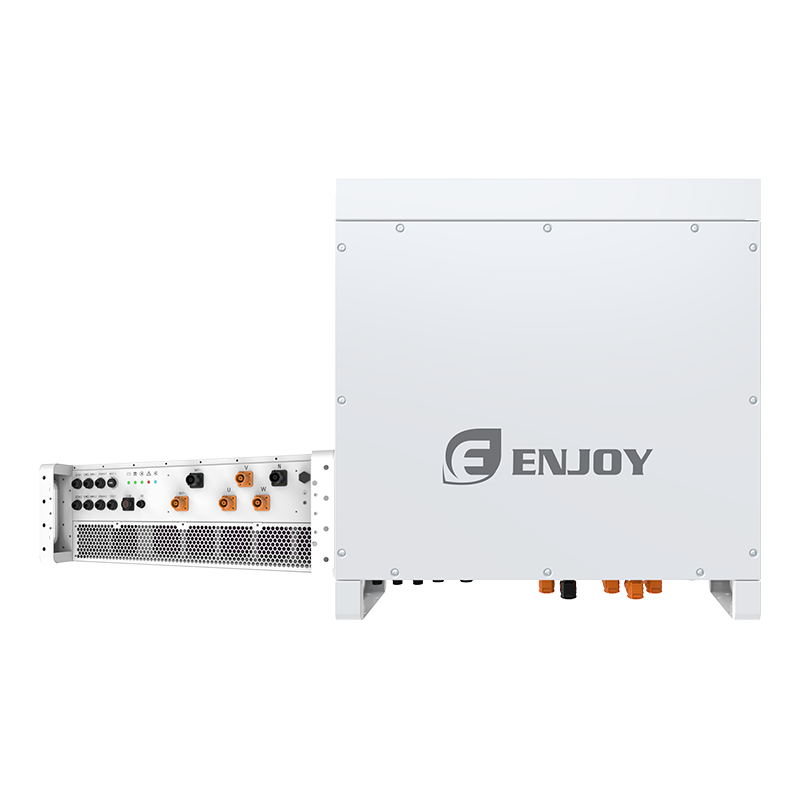

From VF to VSG control and from six PCS units to a 12-unit communication-free parallel system, Enjoypowers helped solve complex power-sharing and motor-starting challenges in an off-grid quarry microgrid.
Project Overview
An off-grid quarry in Africa required a reliable power system capable of supporting continuous industrial production without relying on a stable utility grid.
The project combines solar PV, battery energy storage and diesel generators, with 36 Enjoypowers 125 kW PCS units forming the core power conversion system.
The hybrid energy architecture allows solar PV, batteries and diesel generators to work together to supply the quarry’s electrical loads while maintaining stable voltage and frequency under changing operating conditions.
Unlike a conventional grid-connected energy storage project, an off-grid quarry places particularly demanding requirements on the PCS.
The converters must not only manage battery charging and discharging, but also establish and stabilize the local AC grid, coordinate multiple PCS units in parallel and withstand large transient loads such as industrial motor startup.
During commissioning and operation, the project presented two major engineering challenges:
- Stable current sharing between multiple PCS units when PV power changed rapidly.
- Starting large conveyor motors with extremely high inrush current.
Enjoypowers addressed both challenges through system-level control optimization and parallel PCS architecture redesign.
Project Information
| Project Information | Details |
|---|---|
| Location | Africa |
| Application | Off-Grid Quarry / Industrial Microgrid |
| Energy Sources | Solar PV + Battery Storage + Diesel Generators |
| PCS | Enjoypowers 125 kW PCS |
| PCS Quantity | 36 Units |
| PCS Application | Grid-Forming / Off-Grid Operation |
| Initial Control Mode | VF |
| Optimized Control Mode | VSG |
| Initial Parallel Configuration | 6 PCS Units per Group |
| Optimized Parallel Configuration | 12 PCS Units without Communication |
| PV Capacity | 600 kWp per Initial System Group |
| Motor Running Current | Approx. 180 A |
| Maximum Motor Starting Current | 1,851 A |
| Upgraded Motor-Starting Capability | Approx. 2,400 A |
Challenge 1: Stable PCS Parallel Operation Under Rapid PV Fluctuation
At the beginning of the project, each system group used six PCS units operating in parallel under VF control mode, together with approximately 600 kWp of solar PV.
Under relatively stable operating conditions, the architecture could support the local microgrid.
However, solar generation can change quickly due to clouds and other environmental conditions.
When PV output fluctuated rapidly, the master-slave communication between the PCS units introduced delays into the current-sharing control process.
This meant that the six PCS units did not always respond to the power change at exactly the same time.
As a result, current could become unevenly distributed between the converters.
Some PCS units therefore experienced excessive current and DC-side imbalance, repeatedly triggering:
- Overcurrent protection
- DC bus imbalance faults
These protection events affected the stability of the complete off-grid system.
For an isolated industrial microgrid, this is particularly important because there is no strong utility grid available to absorb short-term disturbances.
The PCS itself must maintain the stability of the local AC network.
Solution: From VF Control to VSG
To improve multi-PCS parallel performance, Enjoypowers changed the system from conventional VF control to VSG — Virtual Synchronous Generator — control.
At the same time, communication between the parallel PCS units was removed from the real-time power-sharing control loop.
Instead of relying on continuous master-slave communication, each PCS could regulate its output independently according to its own droop characteristics.
This allows the converters to share load naturally according to changes in system voltage, frequency and output power.
The control principle is similar to the way multiple synchronous generators can operate together on the same AC bus.
After the VSG control strategy was implemented, the PCS units were able to share current automatically without depending on high-speed communication between master and slave units.
This successfully eliminated the recurring overcurrent and DC bus imbalance issues observed under the previous operating mode.
The result was significantly more stable operation when PV generation changed rapidly.
For this type of off-grid microgrid, the benefit of VSG is therefore not simply a different control algorithm.
It provides a practical way to improve:
- Multi-PCS power sharing
- Dynamic stability
- Grid-forming capability
- Response to renewable-energy fluctuations
- System robustness when communication latency is present
Challenge 2: Starting Large Quarry Conveyor Motors
After resolving the PCS current-sharing problem, the project faced another challenge: starting the quarry’s conveyor motors.
During normal operation, each motor drew approximately 180 A.
However, motor startup required a much higher instantaneous current.
Field measurements showed that the starting current could reach as high as:
1,851 A
This transient current was far beyond what the original six-PCS parallel configuration could reliably provide.
This is a common challenge in off-grid industrial microgrids.
In a conventional grid-connected factory, a strong utility grid can often supply a large portion of the motor’s temporary inrush current.
In an isolated microgrid, however, the local power conversion system must provide that transient current itself.
This makes PCS overload capability, parallel operation and system configuration critical to successful motor startup.
Solution: 12 PCS Units Operating in Parallel Without Communication
To increase the available transient current capability, Enjoypowers redesigned the PCS configuration.
Two PCS groups were combined into a larger system with:
12 PCS Units Operating in Parallel
The upgraded system continued to use the VSG-based communication-free parallel control strategy.
With twelve PCS units working together, the system’s available motor-starting current capability increased to approximately:
2,400 A
This provided sufficient current margin above the measured 1,851 A motor inrush requirement.
During field testing, the first conveyor motor was successfully started.
Once the first motor reached stable operation, its current dropped back toward the normal running level.
This left enough remaining PCS current capability for the second motor to start.
The upgraded architecture therefore resolved the motor-starting problem while maintaining stable off-grid operation.
Why Communication-Free Parallel Control Matters
Large-scale off-grid systems frequently require multiple PCS units to operate together.
One common approach is to use master-slave communication to coordinate power sharing.
However, in systems with fast-changing renewable generation or large transient loads, communication delays can become an important control limitation.
The VSG-based architecture used in this project allows each PCS to participate in voltage and frequency regulation through local control characteristics.
Real-time current sharing therefore does not depend on continuous communication between PCS units.
This provides several practical advantages for complex microgrid applications:
Improved system robustness
A temporary communication delay does not directly interrupt basic power sharing between converters.
Scalable parallel operation
Additional PCS capacity can be used to increase system output and transient load capability.
Better dynamic response
Each PCS can respond locally to electrical changes on the common AC bus.
Improved motor-starting capability
Multiple PCS units can contribute simultaneously to large transient current demand.
For industrial microgrids, these capabilities can be as important as the nominal PCS power rating itself.
Solar PV, Battery Storage and Diesel Generators Working Together
The completed quarry microgrid combines three major energy sources:
Solar PV provides renewable generation and reduces fuel consumption when sufficient solar energy is available.
Battery energy storage absorbs and releases energy dynamically while supporting voltage, frequency and power balance.
Diesel generators provide an additional controllable energy source for periods when renewable generation and battery capacity are insufficient.
Enjoypowers PCS forms the power-conversion and grid-forming layer between the battery system and the AC microgrid.
Through coordinated system control, the different energy sources can work together to provide stable power for quarry production.
Today, the system is operating smoothly and reliably, allowing the quarry’s production equipment to operate continuously in an off-grid environment.
Engineering Beyond the PCS
This project demonstrates an important principle in complex microgrid applications:
Selecting the correct PCS power rating is only part of the solution.
Successful off-grid operation also depends on:
- PCS control strategy
- Parallel architecture
- Grid-forming capability
- Renewable-energy fluctuation management
- Motor-starting requirements
- Transient overload capability
- Battery characteristics
- Diesel-generator coordination
- Overall system engineering
In this project, the final solution required two significant changes:
VF → VSG
and
6 PCS → 12 PCS communication-free parallel operation
These changes transformed the system from an architecture experiencing repeated current-sharing and motor-starting problems into a stable industrial microgrid capable of supporting continuous quarry operation.
Watch the Project Video
See how Enjoypowers solved the PCS parallel-operation and high-inrush motor-starting challenges in this off-grid quarry microgrid.
Project Video:
Off-Grid Quarry Microgrid in Africa with 36 Enjoypowers 125 kW PCS Units
YouTube:
About Enjoypowers 125 kW PCS
The Enjoypowers 125 kW Power Conversion System is designed for commercial, industrial and microgrid energy storage applications.
In addition to conventional grid-connected charge and discharge operation, the PCS supports advanced off-grid and grid-forming applications where voltage and frequency must be actively established and maintained by the power conversion system.
For projects involving multiple PCS units, large motors, diesel generators or high levels of renewable generation, system control architecture is especially important.
The African quarry project demonstrates how Enjoypowers PCS can be applied as part of a multi-megawatt industrial microgrid requiring:
- Multi-PCS parallel operation
- VSG grid-forming control
- High transient current capability
- PV and battery integration
- Diesel-generator coordination
- Stable off-grid operation
Related Product:
Enjoypowers 125 kW Energy Storage PCS
Powering Challenging Off-Grid Applications
Off-grid mines, quarries, factories and remote industrial facilities often face very different electrical challenges from conventional grid-connected energy storage projects.
Large motors, weak-grid conditions, renewable-energy fluctuations and multiple distributed power sources all place additional demands on the energy storage system.
Enjoypowers provides not only PCS hardware, but also technical support for system architecture, PCS parallel operation, VSG control and complex microgrid applications.
From six-PCS VF operation to a twelve-PCS communication-free VSG architecture, this project demonstrates how system-level engineering can help solve real-world problems in demanding industrial microgrids.
Planning an off-grid energy storage or industrial microgrid project?
Contact Enjoypowers to discuss PCS selection, grid-forming control, parallel architecture and system integration for your next project.
Enjoypowers — Enjoy Your Power.