
Connecting high-voltage photovoltaic arrays directly to battery storage racks creates severe voltage matching challenges inside commercial microgrids. Photovoltaic string voltages fluctuate wildly throughout production hours due to ambient temperature shifts and passing cloud cover.
Simultaneously, battery pack voltages vary significantly across charge and discharge cycles as state-of-charge levels move between empty and full states. Unmanaged voltage divergence forces energy assets to operate far below optimal performance curves.
Directly linking these two distinct energy sources to a shared bus without voltage conversion forces arrays to operate far off their maximum power point. Unconverted solar strings underproduce severely when forced to operate at the instantaneous terminal voltage of a depleted battery bank.
Managing these wide voltage differentials requires targeted power electronics capable of decoupling input and output voltage planes while maintaining continuous current flow.
Resolving Dynamic Voltage Disparities Across DC-Coupled Busbars
Solar strings rated for 1000V open-circuit limits experience severe voltage drops during hot summer afternoons, shifting maximum power operating points down toward 400V. Meanwhile, commercial lithium iron phosphate battery racks swing between 450V fully discharged and 850V fully charged.
Forcing a solar array to operate without appropriate voltage conversion and MPPT control can reduce the available energy that the system can harvest.
Traditional AC-coupled energy storage systems attempt to bypass this voltage gap by converting PV power to AC electricity before converting it back to DC for battery charging. However, passing power through double AC/DC conversion stages introduces four to six percent cumulative conversion losses.
Eliminating redundant inversion steps demands a direct DC-coupled architecture where voltage translation occurs across a shared DC bus with minimal conversion overhead.
Operating on a direct DC bus requires hardware capable of wide-range voltage buck and boost operations across unpredictable operating environments. High-voltage side interfaces must accommodate PV array swings from 200V up to 1000V while maintaining full power tracking across a broad 400V to 950V window. Simultaneously, low-voltage side interfaces must regulate power delivery to battery packs spanning 0V to 900V without causing dielectric stress.
Dual-Stage Voltage Regulation and Bidirectional Energy Routing
Decoupling array generation from battery voltage requires separating power processing into dedicated conversion paths. Employing a high-efficiency mppt solar converter ensures maximum power extraction across cloud transitions while stepping solar voltage up or down to match common bus levels.
Fast tracking algorithms update voltage setpoints within fifty milliseconds to capture rapid irradiance changes across fast-moving weather fronts, preventing energy losses.
At Enjoypowers, we engineer three-level power conversion topologies that deliver up to ninety-nine percent peak conversion efficiency across wide operational windows. Lowering switching losses through multi-level modulation keeps thermal dissipation minimal even under maximum current throughput.
High conversion efficiency reduces active cooling demands inside outdoor switchroom enclosures, supporting stable long-term energy delivery and lower operational costs.
Managing battery interaction alongside solar generation requires symmetric energy handling across all operating modes. Integrating a bidirectional dc converter allows energy to flow seamlessly between the DC bus and battery storage racks during alternating charge and discharge routines.
Solid-state switching devices modulate current magnitude precisely based on real-time commands from central energy management controllers, maintaining balance.
Protecting Battery Cells Through Zero-Volt Pre-Charge and Dynamic SoC Tracking
Connecting a fully discharged battery bank to an energized high-voltage DC bus presents massive inrush current risks for facility switchgear.
Standard contactors can weld shut if exposed to unmanaged capacitive current spikes during initial system power-up. Safety protocol demands gradual voltage building before main circuit breakers engage to avoid arc flash hazards.
Supporting zero-volt pre-charge functionality eliminates damaging current surges during cold startup sequences in unconditioned environments. Internal control logic ramps output voltage from zero volts upward, softly energizing battery DC link capacitors until internal potentials match. Soft-starting protects sensitive cell chemistry and extends the service life of heavy-duty DC contactors across thousands of operational cycles.
Utilizing a bidirectional dc converter regulates energy exchange during peak load operating within the voltage and charging limits defined by the battery management system. Firmware-selectable constant-voltage, constant-current, and constant-power modes adapt power delivery based on instantaneous battery temperature and internal resistance.
Modular Parallel Engineering for Megawatt-Scale Commercial Busbars
Scaling DC-coupled storage systems from commercial buildings up to megawatt-hour industrial microgrids requires modular hardware expansion. Connecting multiple conversion modules in parallel allows system integrators to build flexible busbar capacities without re-engineering core electrical distribution panels.
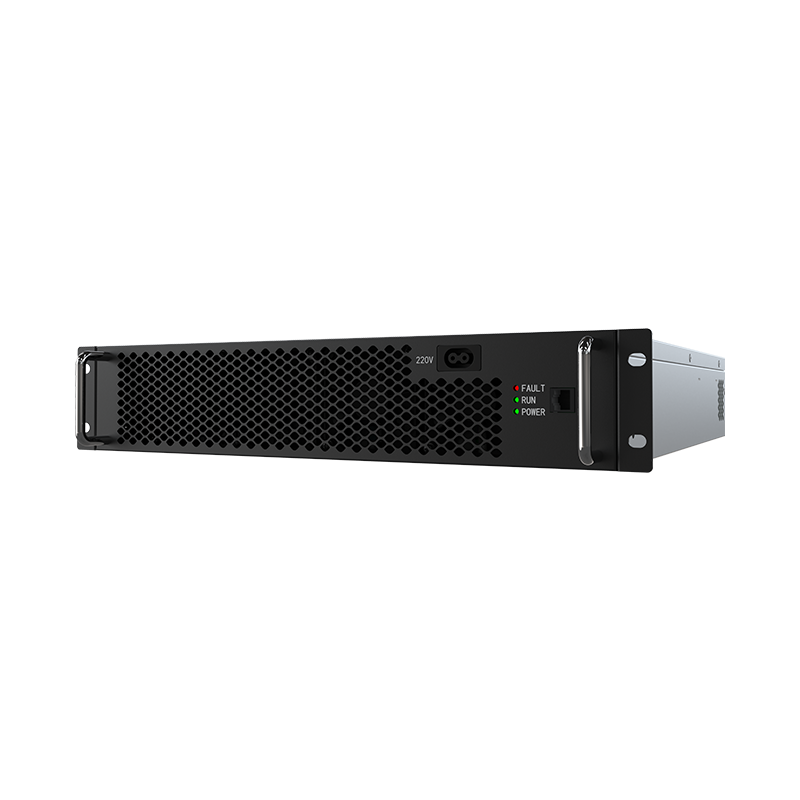
Standardized 50kW and 63kW rack-mounted modules fit neatly inside compact indoor or outdoor power cabinets for easy servicing and installation.
Our engineering team at Enjoypowers developed advanced communication-less load sharing protocols that allow up to sixteen conversion modules to operate simultaneously on a single DC bus.
Eliminating inter-module communication cables removes single point communication failures, ensuring uninterrupted power flow even if an individual controller loses signal connectivity. Parallel modules balance load distribution automatically based on local bus voltage sensing without master-slave dependencies.
Deploying a modular mppt solar converter simplifies array mapping across complex commercial roof layouts with varying string lengths. Integrators can assign dedicated conversion channels to specific solar orientations while combining their outputs on the primary DC busbar. Modular isolation ensures a fault on one string section never disables the entire site’s energy storage infrastructure or battery charging loops.
Harmonizing wide PV string tracking ranges with dynamic battery voltages unlocks maximum operational efficiency for commercial energy storage installations. Direct DC-coupling eliminates unnecessary AC conversion stages, maximizing round-trip energy efficiency across decades of service.
By partnering with Enjoypowers, project developers secure robust, high-efficiency power conversion hardware built to master complex voltage demands across modern industrial microgrids worldwide.