
Industrial manufacturing facilities and commercial operations across the globe lose millions of dollars every year to subtle power distribution disturbances that rarely show up on standard routine maintenance logs.
Unstable grid voltages, severe harmonic distortion, and reactive power demands continuously degrade electrical infrastructure every operational second.
Electrical pollution acts as an aggressive invisible tax on industrial productivity, accelerating mechanical component fatigue, overstressing insulation, and lowering overall system efficiency long before catastrophic hardware failures occur. Facility managers who view power quality issues as minor technical nuisances frequently overlook their massive cumulative impact on annual operational profitability.
Determining the actual economic burden of dirty power requires moving far beyond superficial utility bill analysis to examine holistic capital equipment degradation, expensive unexpected process disruptions, and continuous thermal energy dissipation. Uncovering these hidden operational expenses illustrates precisely why clean power hygiene forms the absolute structural backbone of modern industrial engineering.
How Unseen Electrical Distortions Drive Premature Equipment Degradation
Non-linear industrial loads such as variable frequency drives, arc furnaces, and switched-mode power supplies constantly distort pure sinusoidal AC voltage waveforms throughout internal distribution networks. High-frequency harmonic currents induce significant skin effect in copper conductors, generating localized resistive heating deep inside motor stator windings and main substation transformer cores.
Thermal stress generated by unmitigated harmonic distortion rapidly accelerates the thermal breakdown of critical electrical insulation materials. Operating an electric motor continuously at temperatures just ten degrees Celsius above its design threshold reduces its nominal insulation lifespan by fully fifty percent.
Severe harmonic resonance can also create elevated peak voltage spikes that breach dielectric insulation, leading to short circuits and costly stator failures in sensitive machinery. These continuous dielectric stresses force facility engineers into premature overhaul cycles that severely inflate long-term capital equipment replacement budgets.
Transient voltage sags and sudden swell events exert intense mechanical stress on rotating machinery by creating instantaneous torque pulsations along motor drive shafts. These unpredictable rotational shocks cause severe shaft misalignment, premature gear tooth stripping, and bearing fluting across automated processing lines.
Investing in specialized electrical power quality solutions mitigates these destructive electrical disturbances, maintaining extremely stable and clean voltage baselines for automated assembly lines. Protecting capital assets against harmonic fatigue extends hardware replacement intervals and safeguards initial capital investments across demanding industrial operational environments.
How Voltage Disturbances Trigger Costly Production Shutdowns
Unscheduled operational downtime represents the single most visible, costly, and disruptive financial impact triggered by unmanaged electrical pollution inside modern manufacturing plants. Advanced automated production environments rely heavily on delicate electronic microprocessors, programmable logic controllers, and industrial robotics that automatically trip during brief voltage fluctuations.
A single line-to-ground fault or momentary voltage sag lasting less than one hundred milliseconds can shut down an entire continuous assembly line instantaneously. Recovering from an emergency shutdown often demands multiple hours of manual line clearing, thorough component purging, precision recalibration, and extensive physical inspection before safe commercial output can resume.
The Hidden Cost of Lost Production and Wasted Materials
Mid-process shutdowns generate severe financial losses from ruined raw materials, particularly across precision semiconductor fabrication, pharmaceutical chemical synthesis, continuous plastics extrusion, and high-speed metal stamping operations. Wasted material batches combined with unrecoverable idle labor hours convert minor power dips into devastating quarterly financial operational losses.
Implementing systematic power quality improvement prevents these expensive micro-stoppages, ensuring sensitive automation control hardware remains largely immune to external grid surges and internal load-induced noise. Maintaining unbroken operational uptime preserves planned manufacturing throughput and eliminates emergency overtime expenditures needed to meet critical client contract deadlines.
Reactive Power and Its Impact on Electrical Efficiency
Industrial electrical power distribution systems suffer constant invisible capacity degradation when low displacement power factor and excessive reactive currents flood facility switchgear and feeder cables.
Large inductive motor loads consume substantial reactive power, increasing total current flow without contributing useful mechanical work to facility production output.
Drawing excessive root-mean-square current through distribution infrastructure increases internal copper conductor resistive heating losses exponentially. Electrical energy that should drive productive machinery dissipates instead as wasted ambient heat within switchboard busbars, feeder cables, and step-down power transformers.
Thermal losses inside distribution transformers increase internal cooling demands, forcing facility climate control systems to consume extra energy simply to stabilize substation room ambient temperatures. This secondary energy consumption further inflates monthly operational overhead without adding any functional value to facility manufacturing operations.
Low Power Factor and Harmonics Increase Utility Costs
Regional utility providers enforce severe financial penalties on commercial consumers that maintain low power factor or feed excessive harmonic currents back into public distribution grids. These monthly utility billing surcharges directly increase operational expenses, penalizing facility owners for maintaining inefficient electrical energy consumption patterns.
Suppressing total harmonic current distortion below strict industry standards frees up stranded transformer capacity, enabling facility expansion without requiring costly power substation upgrades. Eliminating wasteful reactive currents significantly lowers monthly utility invoices while substantially improving total facility electrical distribution efficiency.
Why Passive Compensation May Not Be Enough
Traditional passive compensation equipment, including fixed capacitor banks and passive LC tuned filters, frequently fails to deliver adequate performance in modern dynamic factory environments featuring rapidly fluctuating non-linear loads.
Passive capacitors risk dangerous electrical resonance with grid impedance, often leading to blown fuse links, component failure, and severe harmonic magnification.
How Active Harmonic Filters Correct Distortion in Real Time
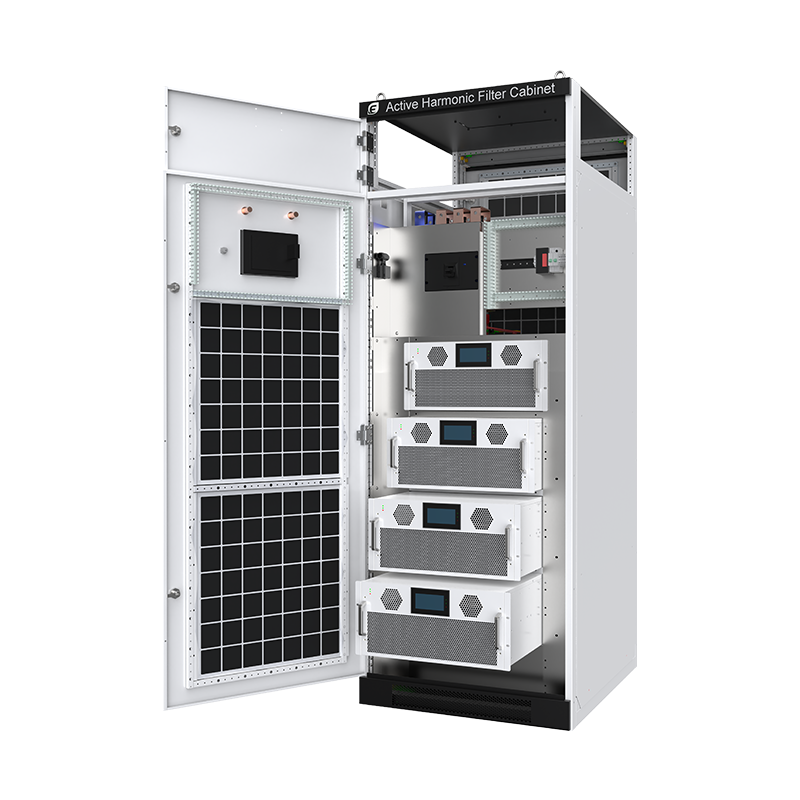
Modern active filtering architectures leverage high-speed digital signal processing algorithms to calculate harmonic distortion and inject equal, opposite corrective currents in real time. At Enjoypowers, we manufacture advanced power conversion systems that dynamically eliminate harmonic distortion up to the fiftieth order while simultaneously compensating for fast-shifting reactive power demands.
Combining active harmonic filtering technology with static var generation achieves response times under five milliseconds, providing immediate dynamic voltage stabilization during heavy industrial motor startups. At Enjoypowers, we engineer these high-performance active power modules to deliver continuous stepless power factor correction targeted precisely at unity zero point nine nine.
Deploying comprehensive electrical power quality solutions restores maximum overall energy efficiency while completely safeguarding facility machinery against premature failure modes.
Dynamic active power mitigation shields sensitive automation controls from disruptive power surges while dramatically mitigating destructive thermal stress throughout primary electrical distribution assets.
The Financial Benefits of Active Power Quality Mitigation
Achieving measurable power quality improvement requires dynamic mitigation hardware capable of responding instantaneously to highly variable operational plant loads.
Purpose-built active correction equipment yields rapid financial payback through immediate utility bill reductions, minimized maintenance requirements, and improved continuous manufacturing process reliability.Resolving electrical power quality pollution directly at the facility level empowers our engineering specialists at Enjoypowers to deliver tailored active compensation systems that defend facility profitability, eliminate expensive operational downtime, and minimize long-term capital ownership expenditures.