
Selecting the underlying converter topology represents one of the most critical hardware engineering decisions when designing commercial battery energy storage systems. Power conversion engineers must evaluate whether a traditional two-level inverter structure or an advanced three-level design best meets long-term project performance targets.
While two-level conversion architectures offer straightforward control logic and fewer switching devices, three-level topologies provide significantly higher energy efficiency and superior power quality. Deciding between these two electrical topologies directly impacts system footprint, cooling overhead, component stress, and capital expenditure.
A rigorous side-by-side technical comparison reveals that the structural differences between two-level and three-level topologies ripple through every physical, thermal, and financial aspect of a battery storage installation. Examining these concrete engineering contrasts highlights how each topology performs under demanding industrial operating conditions.
Direct Voltage Step Comparison: Binary Switching vs. Three-Step Neutral Modulation
Two-level power conversion topologies operate through a binary switching process, driving output AC voltage directly between the full positive DC bus rail and the full negative DC rail. This abrupt, high-amplitude transition forces individual semiconductor switches to endure the full system operating voltage during every single switching event.
In contrast, three-level topologies introduce a central neutral point clamping node, creating three distinct voltage steps per phase leg during AC sine wave reconstruction. Instead of swinging across the entire DC voltage span, three-level switches only transition between the neutral point and either bus rail, effectively cutting the individual voltage step magnitude in half.
Halving the voltage transition step dramatically reduces the rate of voltage change over time across internal power distribution components. Lower voltage stress minimizes insulation degradation in surrounding transformer windings, reduces electrical noise, and prevents electromagnetic interference from radiating into sensitive local control networks.
A three-level energy storage converter can produce a more finely stepped output waveform before passive filtering. Dividing DC bus voltage across stacked switches allows individual power devices to operate well within safe thermal and dielectric limits during rapid switching cycles.
Switching Loss and Thermal Profiles: High Heat Dissipation vs. Low Stress Efficiency
Dynamic switching losses depend on factors such as voltage, current, switching frequency, switching time, and semiconductor characteristics. Two-level topologies experience substantial dynamic switching energy losses because every individual switch transition spans the entire DC bus voltage potential.
Three-level architectures can reduce switching losses under appropriate operating conditions by cutting the switching voltage differential in half during operational cycles. Lower switching energy losses allow three-level converters to run at significantly higher effective switching frequencies without exceeding thermal thresholds or requiring excessive forced air cooling.
Reduced switching losses translate directly into superior partial-load efficiency curves across daily commercial charge and discharge operations. At Enjoypowers, we utilize advanced three-level topologies to support our power hardware maintains high conversion efficiency even under low-power standby or floating charge conditions.
Lower internal heat generation simplifies thermal management systems, reducing fan auxiliary power consumption and minimizing thermal stress on delicate gate driver components. Suppressing internal thermal buildup extends semiconductor device lifespans and protects the energy storage converter from heat-induced failure modes during high ambient summer operations.
Magnetics Sizing Impact: Heavy Filter Chokes vs. Compact High-Density Enclosures
The quality of output alternating current supplied to the commercial facility grid depends heavily on the passive magnetic filters positioned at the converter output. Two-level converters may require more substantial filtering to meet the same output waveform and harmonic requirements, depending on the switching frequency and system design.
Three-level topologies inherently produce a much smoother stepped voltage waveform with significantly lower raw harmonic distortion prior to filtering. Higher effective switching frequencies combined with smaller voltage steps permit the use of dramatically smaller output filter chokes and lighter magnetic cores.
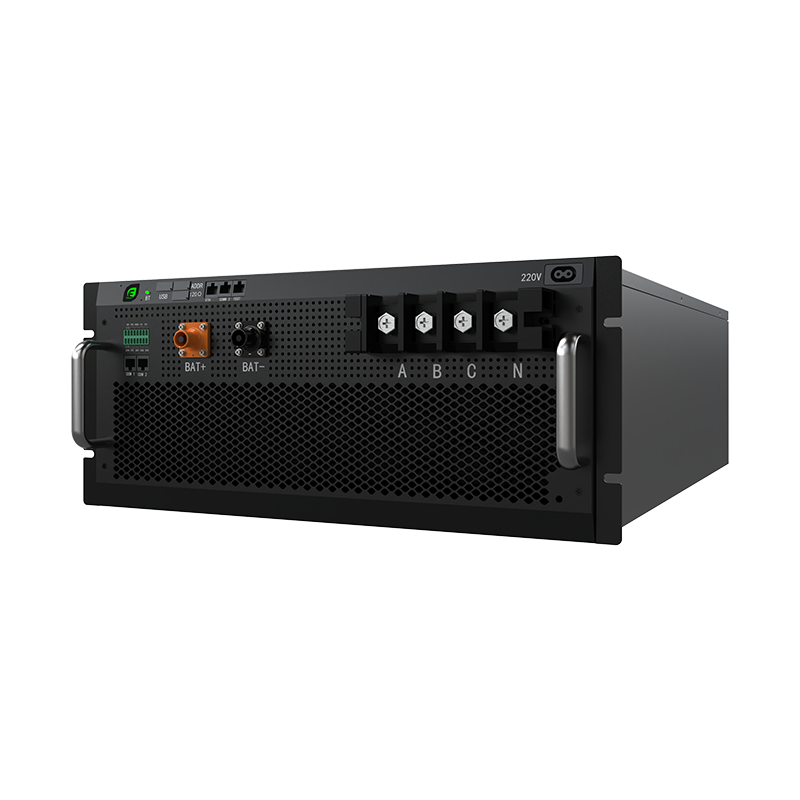
Deploying a compact modular energy storage converter leveraging three-level topology enables system integrators to achieve exceptional volumetric power density in tight spaces. Shrinking the physical dimensions of magnetic inductors reduces overall enclosure weight and frees up valuable internal cabinet space for additional monitoring controls.
Smaller filter inductors also reduce internal copper wire and iron core electrical losses, further boosting total round-trip conversion efficiency. High power density hardware allows commercial facility operators with tight floor space constraints to maximize energy storage capacity within minimal room footprints.
Real-World Architecture Selection: Low-Voltage Simplicity vs. High-Voltage Commercial ROI
Selecting between these two topologies requires matching electrical engineering capabilities with specific project operational requirements and budget constraints. In low-voltage, price-sensitive applications operating below six hundred volts DC, two-level topologies can offer a slightly lower initial purchase price due to simpler gate control logic.
However, as commercial and industrial energy storage systems scale toward one thousand or fifteen hundred volt DC architectures, two-level topologies suffer from severe component voltage stress and excessive thermal losses. Three-level topology can become increasingly attractive for higher-voltage systems to maintain long-term operational reliability and grid compliance.
Here at Enjoypowers, we engineer high-performance conversion systems that utilize three-level technology to deliver maximum energy yield across demanding commercial peak shaving and microgrid applications. Utilizing a versatile modular energy storage converter provides system integrators with scalable power blocks that simplify parallel system expansion.
Commercial facility owners increasingly recognize that the higher initial efficiency of three-level conversion far outweighs minor circuit complexity. Lower thermal losses, reduced filter footprints, and longer equipment lifespans make three-level topology the superior technical and financial choice for modern industrial storage.
Partnering with our engineering specialists at Enjoypowers ensures your storage infrastructure benefits from optimized three-level conversion hardware designed to deliver maximum financial return on investment over decades of operation.