
Data centers operate in a highly demanding electrical environment where uptime, efficiency, and equipment protection are critical. As modern servers, power distribution units (PDUs), and power electronic devices become more advanced, harmonic distortion has become a growing concern for operators seeking stable power performance.
Choosing suitable harmonic filters for data centers requires more than selecting a standard device. Engineers need to evaluate load capacity, harmonic characteristics, voltage levels, and future expansion plans. At Enjoypowers, we provide advanced data center harmonic filter solutions designed to support reliable operation, improve power stability, and help businesses achieve better electrical performance.
Why Data Centers Need Effective Harmonic Filtering
Data center equipment relies heavily on switching power supplies and power conversion technologies. These nonlinear loads can generate harmonic currents that affect the entire electrical system. Excessive harmonics may lead to transformer heating, increased losses, reduced equipment lifespan, and unexpected operational risks.
For modern facilities, maintaining clean power is essential because even minor electrical issues can impact servers, storage systems, and network infrastructure. A properly designed harmonic mitigation system helps operators maintain consistent power conditions while improving overall energy efficiency.
Harmonic filters for data centers work by detecting and compensating for unwanted harmonic currents. Compared with traditional correction methods, advanced active harmonic filters can respond dynamically to changing loads and provide more flexible control for complex data environments.
Key Factors When Sizing a Data Center Harmonic Filter
Selecting the correct data center harmonic filter starts with understanding the electrical characteristics of the facility. The filter capacity should match the harmonic current generated by connected loads rather than simply the total power capacity of the data hall.
Important factors include transformer capacity, server load profile, harmonic spectrum, power distribution design, and expected future growth. Conducting a harmonic survey at the point of common coupling (PCC) provides valuable information for accurate system sizing.
At Enjoypowers, we recommend providing one week of 15-minute interval power data and a representative harmonic spectrum at the PCC for specific harmonic surveys and bill-of-materials sizing. This information allows engineers to design a solution that matches actual operating conditions.
Three Configurations Cover Most Data Center Applications
Different data centers have different power requirements, so a flexible configuration approach is necessary. Enjoypowers provides three typical configurations covering approximately 90% of data center installations.
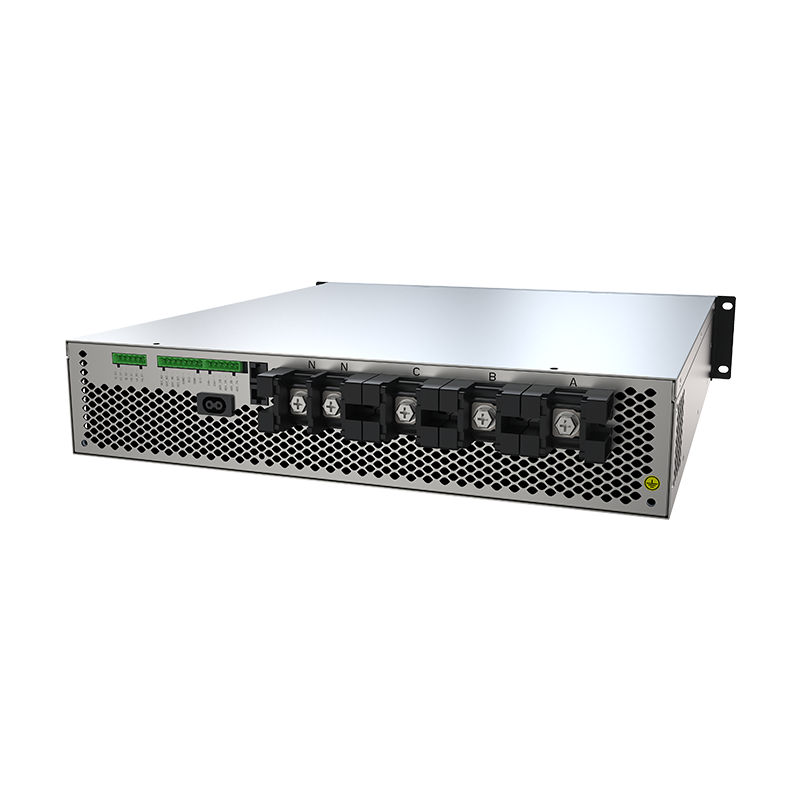
For edge data centers and smaller colocation facilities with 50–200 kVA capacity, Configuration A is designed for compact deployment. The solution includes one to two SinL Pro 50–100A active harmonic filter modules with a plug-in form factor for rack mounting near the PDU.
This configuration typically operates at 400 V, which is the most common voltage level for these applications. If reactive power compensation is required, SinL Pro 25–50 kVar SVG modules can also be integrated. It is suitable for edge computing sites, small enterprise data halls, and regional colocation facilities.
For mid-size data centers ranging from 200 kVA to 2 MVA per data hall, Configuration B provides higher capacity and flexible cabinet installation. The system can include four to eight SinL Pro 150A or SinE 200A modules installed in a cabinet configuration.
Depending on the transformer design, the operating voltage can be 400 V or 690 V. SVG capacity is configured according to the facility’s reactive power profile. This solution is commonly applied in Tier II and Tier III colocation facilities and single-tenant data centers where stable power quality is essential.
For hyperscale facilities exceeding 2 MVA per data hall, Configuration C offers a scalable architecture using multiple SinL Pro Cabinets in an N+1 configuration. Installation points can include both individual PDU levels and facility-level systems depending on the power distribution structure.
These large-scale systems typically operate at 690 V or higher on the main bus. They are designed for hyperscale data centers and major cloud provider facilities that require high reliability and continuous power quality management.
Active Harmonic Filters Improve Data Center Reliability
Compared with conventional filtering approaches, active harmonic filters provide real-time compensation and can adapt to changing data center workloads. This capability is particularly valuable because server demand changes constantly based on computing requirements.
Enjoypowers’ active harmonic filtering technology helps data centers manage harmonic distortion while supporting stable electrical operation. By combining harmonic compensation with optional reactive power management, our solutions provide a comprehensive approach to improving power performance.
A properly selected filter can help reduce electrical stress on infrastructure, improve energy efficiency, and support long-term equipment reliability. These benefits make advanced filtering technology an important investment for facilities with strict uptime requirements.
Building Future-Ready Data Center Power Systems with Enjoypowers
As data centers continue expanding in scale and complexity, reliable power management becomes increasingly important. Selecting the right harmonic filters for data centers requires accurate assessment, proper sizing, and a solution designed around real operating conditions.
At Enjoypowers, we focus on developing professional power quality solutions that address the challenges of modern industrial and digital infrastructure. Our data center harmonic filter products support applications ranging from edge facilities to hyperscale environments, helping customers maintain improve power quality and system reliability, improve system reliability, and build resilient energy infrastructures worldwide.