
What Is an Active Harmonic Filter?
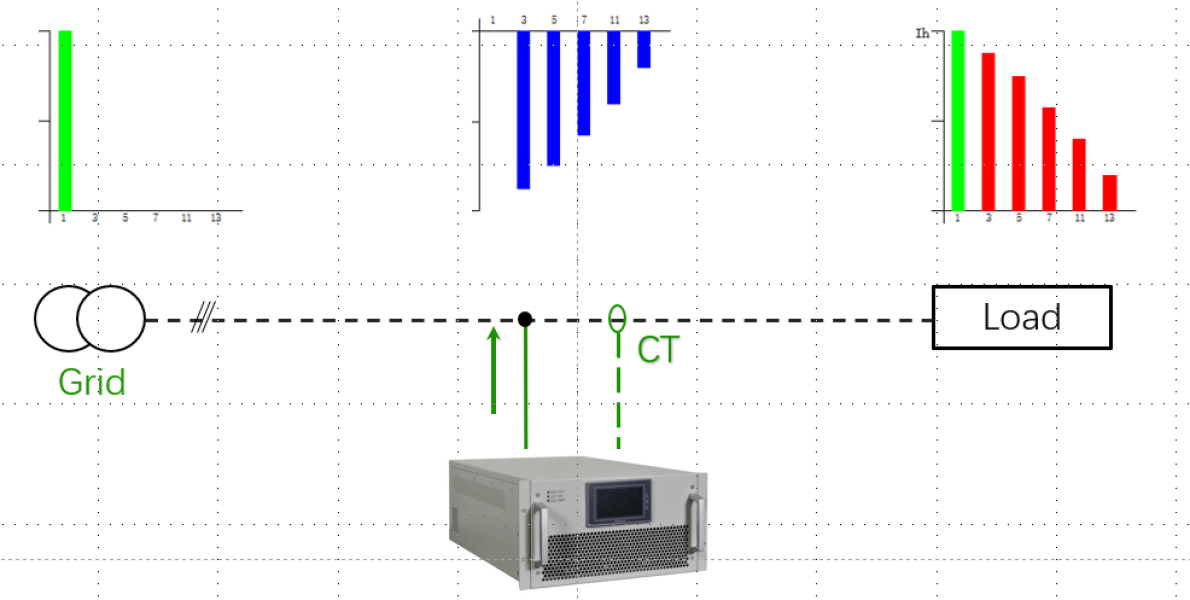
An Active Harmonic Filter (AHF), also known as an Active Power Filter (APF), is a power electronic device designed to mitigate harmonic currents generated by nonlinear loads.
Typical nonlinear loads include:
- Variable frequency drives
- Rectifiers
- UPS systems
- Data center power supplies
- Industrial automation equipment
- Welding equipment
- EV charging equipment
- Other power-electronic loads
Unlike passive filters that rely on fixed combinations of capacitors and reactors, an AHF continuously measures the electrical system and generates compensation current according to actual load conditions.
This makes active harmonic filtering particularly suitable for electrical systems where load conditions change frequently.
Why Harmonics Need to Be Controlled
Nonlinear loads do not draw perfectly sinusoidal current from the grid.
Instead, they generate harmonic currents at multiples of the fundamental frequency. When these harmonic currents circulate through transformers, cables and switchgear, they may lead to:
- Increased current distortion
- Additional transformer and cable losses
- Higher equipment temperature
- Reduced usable system capacity
- Nuisance tripping
- Capacitor overheating or failure
- Interference with sensitive electrical equipment
- Reduced overall power quality
The severity of these effects depends on the harmonic spectrum, system impedance, load characteristics and the electrical distribution architecture.
Therefore, harmonic mitigation should be based on actual measurement rather than only on installed load capacity.
How Does an Active Harmonic Filter Work?
An AHF is normally connected in parallel with the load or electrical distribution system.
The basic operating process can be divided into four steps.
1. Current Measurement
Current transformers measure the current at the required measurement point.
The exact CT location and wiring method depend on the compensation strategy and product configuration, so installation should always follow the corresponding product manual and system design.
2. Harmonic Analysis
The controller analyzes the measured current in real time and separates the fundamental component from unwanted harmonic components.
Digital signal processing algorithms are used to determine which harmonic currents need to be compensated.
3. Compensation Current Generation
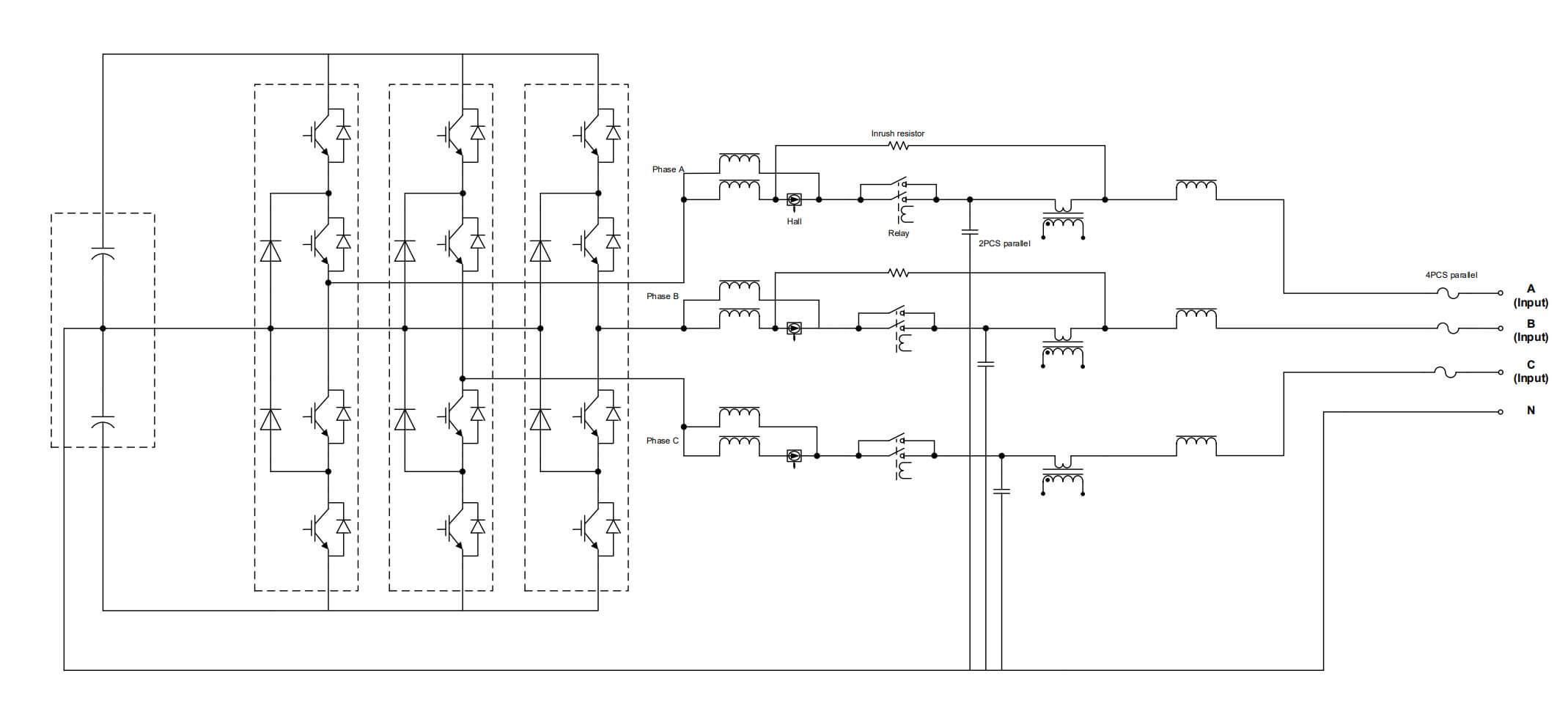
The power electronic converter generates a compensation current corresponding to the detected harmonic components.
For harmonic compensation, the injected current has approximately the same magnitude but opposite phase to the unwanted harmonic current.
4. Grid-Side Current Improvement
The compensation current and the load harmonic current cancel each other at the compensation point.
As a result, the current seen by the upstream grid becomes closer to a sinusoidal waveform.
A Simple Example
Assume an industrial load produces significant 5th- and 7th-order harmonic currents.
Without compensation:
Grid current = fundamental current + harmonic current
After the AHF detects these harmonic components, it generates corresponding compensation currents.
The upstream system then sees approximately:
Grid current = load current + AHF compensation current
Ideally, most of the targeted harmonic component is cancelled, reducing total harmonic current distortion.
Actual performance depends on factors including:
- AHF capacity
- Harmonic spectrum
- Load fluctuation
- CT installation
- System impedance
- Background voltage distortion
- Compensation settings
Harmonic Compensation Is Not the Only Function
Modern active power quality equipment can provide more than harmonic filtering.
Depending on product configuration, an AHF/SVG-based system may also support functions such as:
Reactive Power Compensation
The converter can generate capacitive or inductive reactive current to help improve power factor.
Three-Phase Unbalance Compensation
In suitable three-phase four-wire applications, active compensation can help reduce phase-current imbalance caused by uneven single-phase loads.
Dynamic Compensation
Because the system continuously monitors electrical conditions, compensation can respond to changing loads without relying solely on fixed capacitor stages.
Active Harmonic Filter vs. Passive Harmonic Filter
Passive filters normally consist of capacitors, reactors and resistive components tuned to specific frequencies.
They can be effective in stable systems, but their behavior depends strongly on system impedance and operating conditions.
Active harmonic filters instead use controlled power electronics.
Their main advantages include:
- Dynamic compensation
- Ability to address multiple harmonic orders
- Flexible capacity expansion
- Reduced dependence on fixed tuning frequencies
- Better suitability for rapidly changing loads
However, the most appropriate solution depends on the project.
For some large installations, hybrid solutions combining active and passive technologies may provide a better balance between performance and cost.
How to Select an AHF
Correct AHF sizing should not be based only on transformer capacity or load power.
Important information normally includes:
- System voltage
- Transformer capacity
- Load current
- Measured THDi
- Harmonic spectrum
- Target harmonic level
- Major nonlinear loads
- Existing capacitor banks
- CT ratio and installation position
- Single-line diagram
Where possible, actual power-quality measurements should be used.
For new projects without field measurements, harmonic estimation can be performed based on load type, equipment quantity and expected operating conditions.
Typical Applications
Active harmonic filters are widely used in applications including:
- Data centers
- Manufacturing plants
- Semiconductor facilities
- Commercial buildings
- HVAC systems
- Water treatment
- Mining
- Oil and gas
- Renewable energy systems
- EV charging infrastructure
The objective is not simply to obtain a lower THDi number, but to improve the reliability and usable capacity of the electrical system.
About Enjoypowers Power Quality Solutions
Enjoypowers develops power-electronic solutions for harmonic mitigation, reactive power compensation and other power-quality applications.
Our Power Quality portfolio includes active harmonic filtering and static VAR compensation solutions for commercial and industrial electrical systems.
For project selection or system analysis, prepare your single-line diagram and available power-quality measurements and contact our engineering team.
Contact: sales@enjoypowers.com
Contact page: https://enjoypowers.com/contact/